During postpartum shedding, most mothers focus on how much hair is falling out—but overlook another equally important factor that directly affects how full and healthy the hair looks:
👉 Heat Damage.
Blow-dryers, curling irons, flat irons, and heated brushes may seem harmless, but for postpartum hair—which is drier, more fragile, and more sensitive to environmental stress—heat becomes a major hidden threat:
- Damage happens faster
- Recovery is slower
- The impact on visual hair density is bigger
For a full framework on how daily care supports a calmer scalp and better recovery, see our Postpartum Scalp Care guide.
This guide breaks down:
- Why postpartum hair is extra vulnerable to heat
- What high temperature really does to your scalp and hair
- How to dry your hair safely
- What temperature is actually “hair-safe”
1. Why Postpartum Hair Is More Prone to Heat Damage
Your body enters a high-sensitivity, high-fluctuation state after giving birth. Both the scalp and the hair shaft become more fragile for several physiological reasons.
1) The scalp barrier becomes thinner and more reactive
The sudden drop in estrogen and progesterone leads to:
- A weaker lipid barrier
- Faster water loss
- A reduced ability to tolerate heat
- Increased sensitivity and inflammation
Hot air can easily trigger:
- Burning or stinging
- Redness
- Tiny inflamed bumps
- Seborrheic dermatitis flare-ups
- Slower recovery from shedding
If cleansing is also too harsh, this sensitivity worsens. A gentle, low-irritation shampoo routine (see why gentle cleansing matters so much postpartum) is the foundation for tolerating any styling at all.
2) Hair loses moisture → keratin becomes brittle
During pregnancy, estrogen helps the hair retain moisture, making it shiny and full.
After delivery, the drop in estrogen causes:
- Dryness
- Reduced elasticity
- Brittle, breakage-prone strands
Once keratin is heat-damaged:
- Split ends appear
- The hair shaft becomes thinner
- Visual hair density decreases
👉 Many mothers mistake heat-induced breakage for “more shedding.”
3) Stress + sleep loss weaken hair structure
Postpartum cortisol levels can remain elevated due to:
- Sleep deprivation
- Stress from caregiving
- Physical recovery
High cortisol accelerates protein breakdown in the hair shaft, making it far easier for heat to cause structural damage. Combining stress relief and gentle scalp stimulation (for example, scalp massage to support resting follicles) with appropriate heat care can noticeably improve overall recovery.
2. What High Heat Really Does to Hair (Scientific View)
Here’s what most people don’t know:
🔥 Keratin begins to break down at 60–70°C (140–158°F)
🔥 Blow-dryers on “hot” reach 90–120°C (194–248°F)
🔥 Curling/flat irons: 150–200°C+ (300–392°F)
Meaning:
Every time high heat touches your hair, damage is nearly guaranteed.
Heat causes five major problems:
① Cuticle lifting → frizz and tangles
Lifted cuticles =
• higher friction
• more breakage
• rough texture
• harder detangling
② Keratin breakdown → split ends
Once a split end forms, it keeps traveling upward, thinning the entire strand.
③ Hair shaft thinning → flatter, “thinner” appearance
Heat destroys the internal protein matrix →
hair diameter reduces →
visual density drops.
④ Color dullness or yellowing
Especially noticeable on brown, blonde, or chemically treated hair.
⑤ Scalp inflammation → slower postpartum recovery
Heat triggers micro-inflammation, which:
- Irritates the scalp
- Worsens sensitivity
- Delays the shift from telogen → anagen
A stabilized scalp environment (oil balance, microbiome, inflammation) is key here—see scalp environment management for faster recovery.
3. How to Dry Your Hair Safely (The Gentle Drying Method)
If you follow these steps consistently for 2–6 weeks, your hair quality will noticeably improve.
Step 1: Press, don’t rub with a towel
Rubbing =
• friction
• cuticle damage
• breakage
Correct method:
Fold a soft towel over the hair and gently press to absorb water.
This also reduces mechanical damage–type “false shedding” (more on this concept here: avoiding mechanical damage after postpartum hair loss).
Step 2: Let hair air-dry to 50% before blow-drying
Wet hair is at its most fragile stage.
Blow-drying immediately causes:
- Greater heat damage
- Higher breakage
- More frizz
When hair dries halfway on its own:
- Heat exposure drops by 50%
- Breakage significantly decreases
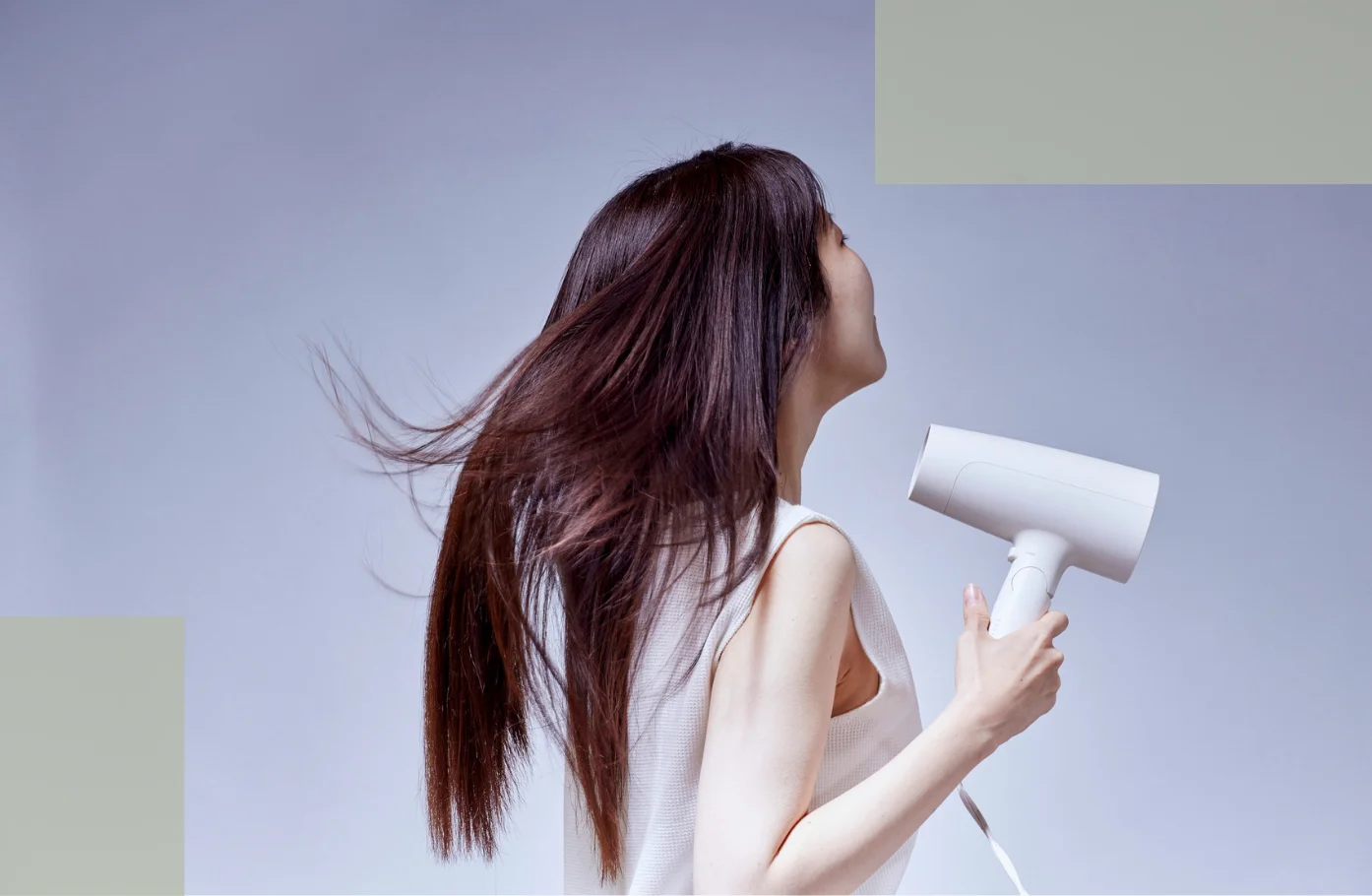
Step 3: Use medium–low temperature (never “hot”)
Hot settings reach levels that instantly damage keratin.
Gentle-drying rules:
- Use cool or medium heat
- High airflow, low temperature
- Keep the nozzle 15–20 cm (6–8 inches) away
- Avoid directing hot air onto the scalp
📌 Cool is always safest.
Step 4: Dry roots first, ends last
Reason:
- Roots need to dry quickly to prevent scalp irritation
- Ends are the most fragile → expose them to the least heat
Step 5: Limit hot tools (especially during the first 6–12 months postpartum)
Temperature guidelines:
- 150°C (300°F) → instant keratin weakening
- 180°C (356°F) → deep structural damage
- 200°C (392°F) → permanent hair shaft injury
Recommendations:
- Avoid hot tools for 6–12 months postpartum
- If necessary, keep tools below 120–150°C (248–302°F)
- Use sparingly
Your overall routine (how you wash, how often you wash, and what you do before/after drying) matters too. To set a heat-friendly rhythm, see wash frequency for postpartum hair loss.
4. Combine Gentle Heat Management + Moisture → Faster Recovery
If you pair gentle drying with:
- A moisturizing conditioner or mask
- Oils that reduce friction (like grapeseed, argan, or batana)
You will see:
- Less breakage
- Fewer split ends
- Smoother texture
- Fuller-looking hair
- Less “false shedding”
Many mothers think they keep shedding excessively—but what they’re actually seeing is:
👉 heat-induced breakage + postpartum dryness.
5. Common Heat-Damage Mistakes to Avoid
❌ Rubbing vigorously with a towel
❌ Blow-drying soaking-wet hair
❌ Using the hottest setting
❌ Holding the dryer too close
❌ Detangling when fully wet
❌ Curling/straightening daily
❌ Using tools above 150°C
❌ Dyeing/perm during early postpartum
These habits stack on top of mechanical and washing-related damage. Learning how to handle your hair physically (combing, tying, towel use) is just as important—see how to avoid mechanical damage and false shedding if you haven’t already integrated those changes.
6. What You’ll Notice After 2–8 Weeks
After 2–4 weeks:
- Less breakage
- Less frizz
- Smoother ends
- Scalp feels calmer
- Fuller-looking roots
After 8–12 weeks:
👉 Less “shedding” (because breakage has reduced)
👉 A visible improvement in thickness and overall density
This improvement is even more obvious when combined with other gentle routines (like mild cleansing and basic scalp stimulation, e.g. scalp massage).
Conclusion: Gentle Heat Management = A Protective Shield for Postpartum Recovery
Gentle drying isn’t just about protecting the hair shaft—it protects the scalp barrier, the follicle environment, and the entire recovery process.
It helps:
- Reduce mechanical + heat damage
- Preserve the cuticle
- Limit inflammation
- Support new growth
- Improve texture
- Enhance visual fullness
Postpartum recovery isn’t only about growing new hair—
it’s also about protecting the hair you already have.
And gentle heat management is one of the easiest, most impactful ways to do that.
If you want to understand why shedding peaks around 3–6 months postpartum, our Postpartum Hair Loss guide breaks it down clearly.
If you’re looking for a postpartum-friendly shampoo, the Evavitae Root Fortifying Hair Essence fits well with a gentle recovery routine.