
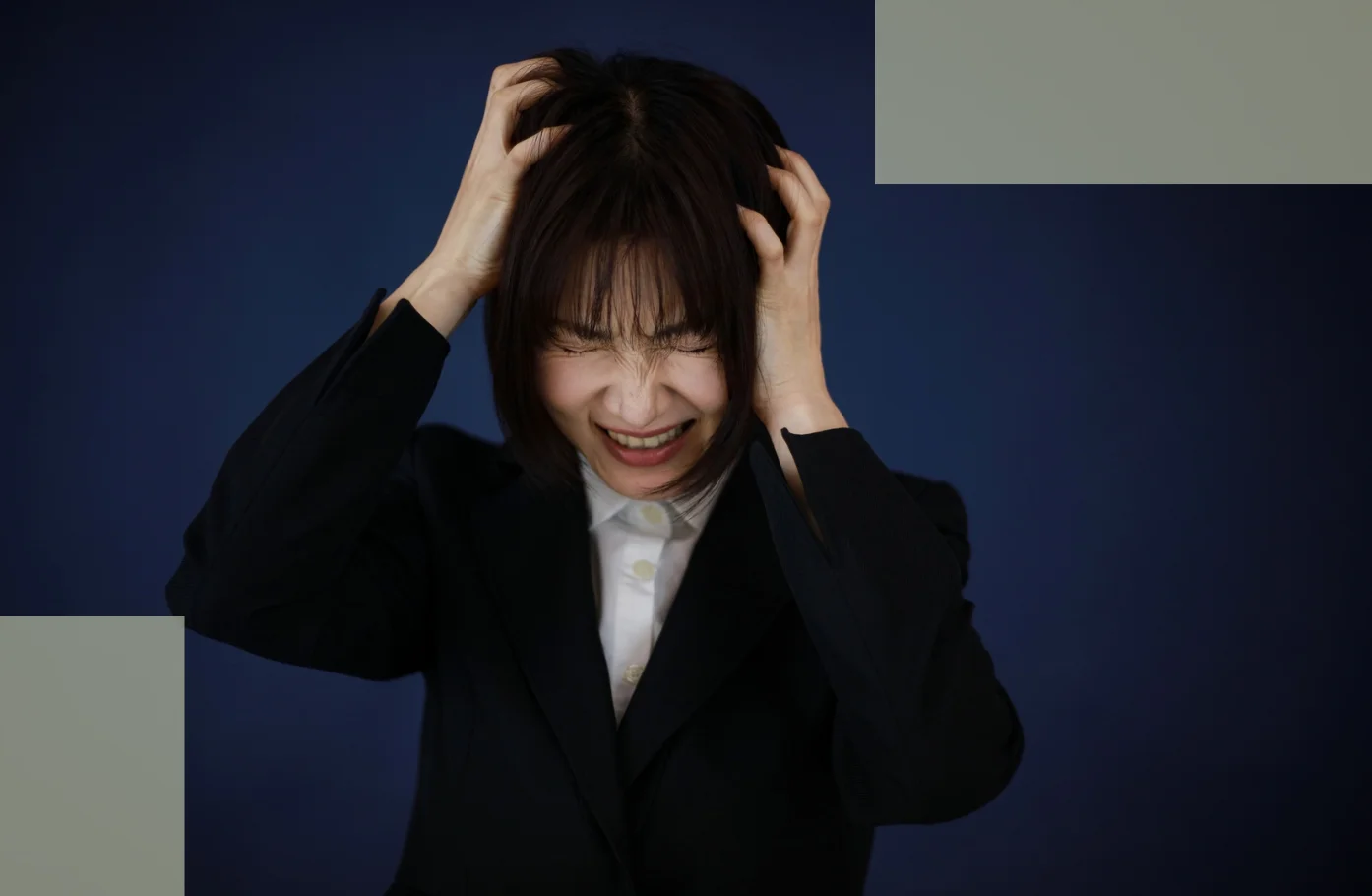
Many people find themselves comparing during the early stages of shedding:
“Others around me are just as busy, tired, and anxious — so why am I the one losing hair?”
The answer is not about who is “weaker.”
It’s about whose body is more likely to downgrade hair growth first under stress, a pattern that becomes clear when stress-related shedding is viewed within the broader framework of stress hair loss.
The following groups are considered high-risk populations for stress-induced hair loss.
1️⃣ The “High-Functioning Anxiety” Type
Calm on the surface — tightly wound underneath
This is one of the most common and most overlooked risk groups.
People in this category often:
• Perform well at work
• Carry strong responsibility
• Appear calm, disciplined, and reliable
• Rarely experience emotional breakdowns
But their internal state is often:
• Chronically tense
• Driven by high self-expectation
• Rarely truly relaxed
• Living with alertness as the default mode
📌 The issue isn’t whether you can endure stress — it’s whether you ever truly exit stress mode.
In this group, the nervous system often stays in a long-term high-alert state, creating fertile ground for stress hair loss, a pattern examined in detail among high-functioning anxiety types who start shedding without realizing it.
2️⃣ Postpartum Women
Multiple stressors compressed into a short time span
Postpartum women are naturally at high risk for stress-related hair loss.
Not because of hormones alone — but because several stress pathways converge at once:
• Rapid hormonal shifts
• Chronic sleep interruption
• Ongoing physical recovery
• Sudden increase in responsibility and identity load
• Emotional suppression (“I must be strong,” “I have to manage”)
📌 This is a classic overlap of psychological stress × physiological stress × sleep deprivation, which explains why postpartum women are more prone to prolonged shedding and slower stabilization.
As a result, mixed-type stress hair loss is extremely common postpartum, often characterized by:
• Prolonged shedding duration
• Slower recovery
• Strong feedback between emotional stress and hair loss anxiety
3️⃣ Chronic Sleep Deprivation or Shift-Work Patterns
Bodies that never receive a “safe repair window”
This group includes people who:
• Stay up late long-term
• Have highly irregular schedules
• Work night shifts or rotating shifts
• Experience frequent sleep interruption
📌 For the body, this sends one clear message: the night-time rhythm has never stabilized.
Hair growth, nervous system down-regulation, and sensitive tissue repair all depend on nighttime circadian confirmation.
Even without strong emotional stress, persistent sleep disruption alone can be enough for the body to pause hair growth, which is why chronic sleep deprivation and shift work often make hair the first system to give way.
4️⃣ People with Pre-Existing Hair Loss Tendencies
Stress becomes the final amplifier
This group is often misinterpreted as:
“Is my original hair loss type getting worse?”
But the more accurate picture is:
👉 A vulnerable baseline + stress = earlier and more visible symptoms
Common overlaps include:
• Genetic hair loss + stress
• Hormone-related hair loss + stress
• Postpartum hair loss + psychological stress
• Nutritional hair loss + stress
📌 In these cases, stress is not the sole cause — it acts as a magnifier, exposing existing fragility.
As a result, these individuals often experience:
• Earlier onset
• Slower stabilization
• Higher sensitivity to stress fluctuations
This is why recovery is often slower and more unstable when stress overlaps with other hair loss types.
Why Do These Groups Transition from “Handling Stress” to “Losing Hair”?
They share one underlying factor: a chronic absence of a true safety window.
Whether through:
• Persistent emotional tension
• Interrupted or unstable sleep
• Incomplete physical recovery
• Multiple stress pathways stacking together
The nervous system eventually forms a default conclusion:
👉 “The environment is unstable.
Now is not the time to invest in growth.”
Hair — a high-energy, non-essential system — becomes one of the first functions to be downgraded, a prioritization pattern that aligns with the core causes of stress hair loss identified across different physiological pathways.
At this stage, gentle external support — such as a root-fortifying hair essence designed to help stabilize the scalp environment during systemic recovery — can be helpful, but only when internal stress signals are no longer continuously reinforcing danger.
A Crucial Cognitive Correction
Belonging to a high-risk stress hair loss group is not because you’re weak.
It’s because you’ve been operating in depletion for too long.
Your body simply pressed the brakes before you noticed.
Final Thoughts | Risk Does Not Equal Destiny
If you recognize yourself in any of these categories:
✅ This is not bad news
✅ It means your shedding pattern is understandable and explainable
In stress hair loss, “risk” is not a prediction of poor recovery.
It clarifies where recovery needs to be aimed.
The next step isn’t to push harder — it’s to systematically exit long-term high alert.