
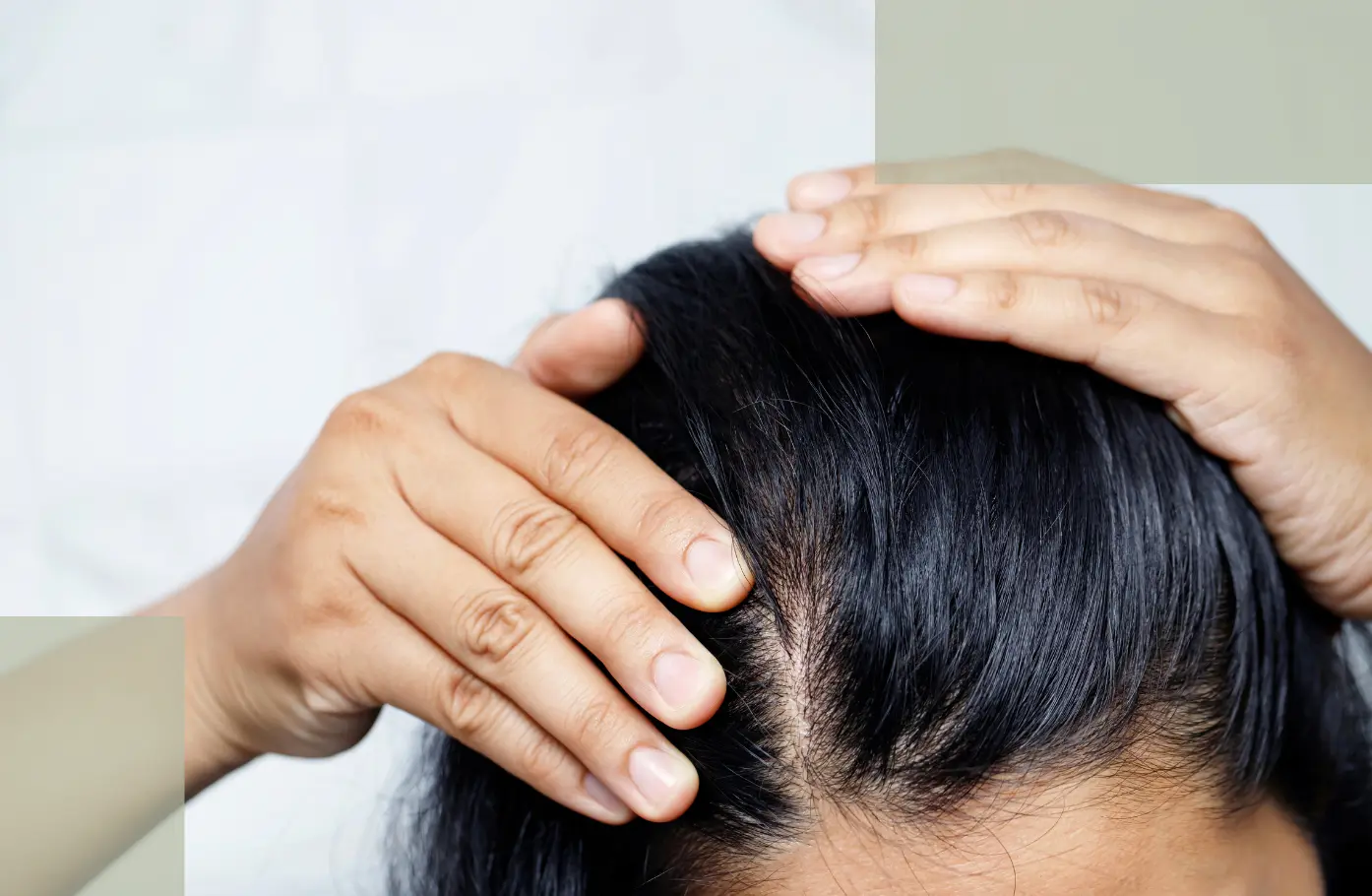
Why stress hair loss pushes people into overcare mode
When people experience stress-related hair loss, most fall into an instinctive cycle:
Shedding → panic → searching → buying → aggressive use
This reaction is understandable.
Hair loss triggers urgency, and urgency creates action.
But here’s the uncomfortable truth:
👉 Stress hair loss is not caused by a lack of stimulation.
It is caused by a system that does not yet feel safe enough to recover — a core mechanism explained in stress-related hair loss and recovery principles.
And excessive care — even well-intentioned care — often becomes a new stressor that delays recovery.
The single most important principle (read this first)
The goal of caring for stress hair loss is simple:
Keep the scalp and the body feeling consistently safe.
Not:
- Forcing growth
- Accelerating results
- Chasing visible effects
But:
- ✅ Avoiding new stress signals
- ✅ Avoiding interruptions to recovery mechanisms
- ✅ Providing predictability, not intensity
Everything else in care follows this principle — especially stress hair loss–specific scalp care strategies.
1. Cleansing: washing less does not reduce shedding
A common fear during stress hair loss is:
“If I wash less, I’ll lose less hair.”
This seems logical — but biologically, it’s incorrect.
The truth about washing and shedding
- Stress hair loss is not caused by washing
- Washing does not pull out healthy growing hair
- Hair that falls during washing was already in the telogen phase
When telogen hairs release, they do so regardless of whether you wash — washing simply reveals what is already detached.
Avoiding cleansing can actually make things worse, a misconception explained in why washing your hair less is not the answer during stress hair loss recovery.
- Oil accumulation
- Microbial imbalance
- Low-grade scalp inflammation
All of which slow recovery, not protect it.
Better cleansing logic
- Use gentle, non-stripping cleansers
- Wash based on scalp comfort, not fear
- Aim for a clean, calm scalp — not dryness or tightness
📌 Key reminder:
More hair in the drain does not mean washing caused the shedding.
It means the shedding phase is completing.
2. Product selection: avoid the “stimulate harder” mindset
During stress hair loss, many products are marketed around one idea:
“Wake the follicles up.”
But follicles in stress hair loss are not asleep — they are intentionally paused for protection.
This is why avoiding the stimulation-logic when choosing hair care products is essential during recovery.
What supports recovery-stage follicles
Products better suited for stress hair loss recovery usually share these traits:
- Mild surfactant systems
- Low irritation potential
- No aggressive heating or cooling sensations
- No pressure for “instant volume” or “visible reaction”
Products that often backfire
- Strong degreasers
- Intense menthol or capsaicin
- High-dose “growth actives” used too early
- Frequently switching formulas
📌 Reality check:
Hair follicles don’t need to be shocked into action.
They need to stop being classified as “under threat.”
3. Scalp care: gentler care often equals more advanced care
A stressed scalp is rarely a resilient scalp.
In stress hair loss, the scalp is often:
- Highly sensitive
- Reactive to stimulation
- Slow to calm
This is why a gentler scalp-care approach is actually the more advanced recovery strategy.
What helps
- Light, non-forceful massage
- Relaxation-oriented washing
- Occasional heat for comfort (not intensity)
These actions reduce muscular tension and support circulation without triggering alarms.
What to avoid
- Scraping tools
- High-frequency devices early in recovery
- Using pain, heat, or tingling as “proof of effectiveness”
📌 If it hurts, burns, or numbs — the body interprets it as risk, not healing.
4. Care rhythm: consistency matters more than “perfect choices”
One of the biggest hidden mistakes during recovery is constant adjustment.
Many people do this:
- Change routines after one bad shedding day
- Switch products weekly
- Combine multiple treatment goals at once
But follicles don’t respond to short-term data.
Why rhythm matters
Hair follicles evaluate environment over weeks, not days.
A stable routine held for 4–8 weeks allows follicles to:
- Build trust in the environment
- Maintain growth signals
- Avoid repeated pause-restart cycles
They evaluate environment over weeks, not days — which is why care rhythm and long-term stability matter more than doing everything “right”.
📌 From the follicle’s perspective:
Predictable = safe.
5. Daily behavior: the most underestimated layer of “care”
Many people believe care begins and ends in the shower.
In reality, daily behavior communicates more than products ever can — a principle explored in why gentle hair care alone isn’t enough during stress hair loss recovery.
Hidden factors that shape recovery
- Sleep regularity
- Day-time tension levels
- Obsessive checking habits
- Constant comparison to others
Someone can use “all the right products” — but still send their body a daily message:
“I’m under pressure.”
📌 Care is not just what touches your scalp.
Care is the overall signal your body receives repeatedly.
6. When is it appropriate to “upgrade” care?
A crucial question that’s rarely addressed clearly.
You may consider gradually strengthening support only when:
- Shedding has clearly decreased
- Scalp discomfort has resolved
- Early regrowth is stable and consistent
These markers signal that the timing for upgrading care has arrived — not the need for more intensity.
At this stage, a gentle, barrier-respecting support product — such as a mild, root-supporting hair essence designed for sensitive recovery phases — is often more appropriate than aggressive interventions.
7. The 6 most common care mistakes in stress hair loss
Mistake | What it causes |
Washing less to reduce shedding | Poor scalp environment |
Equating刺激感 with efficacy | Inflammation & reactive shedding |
Assuming price equals suitability | Mismatched recovery stage |
Changing routines too often | Interrupted recovery |
Focusing only on the scalp | Ignoring systemic stress |
Trying to “fix it fast” | Anxiety becomes resistance |
A final one-sentence care philosophy
Stress hair loss is not caused by doing too little.
It is prolonged by doing too much, too urgently.
Recovery begins when care shifts from:
“What more can I do?”
to
“What pressure can I stop adding?”
When the body feels safely held in time, hair recovery becomes a natural consequence — not a battle.