
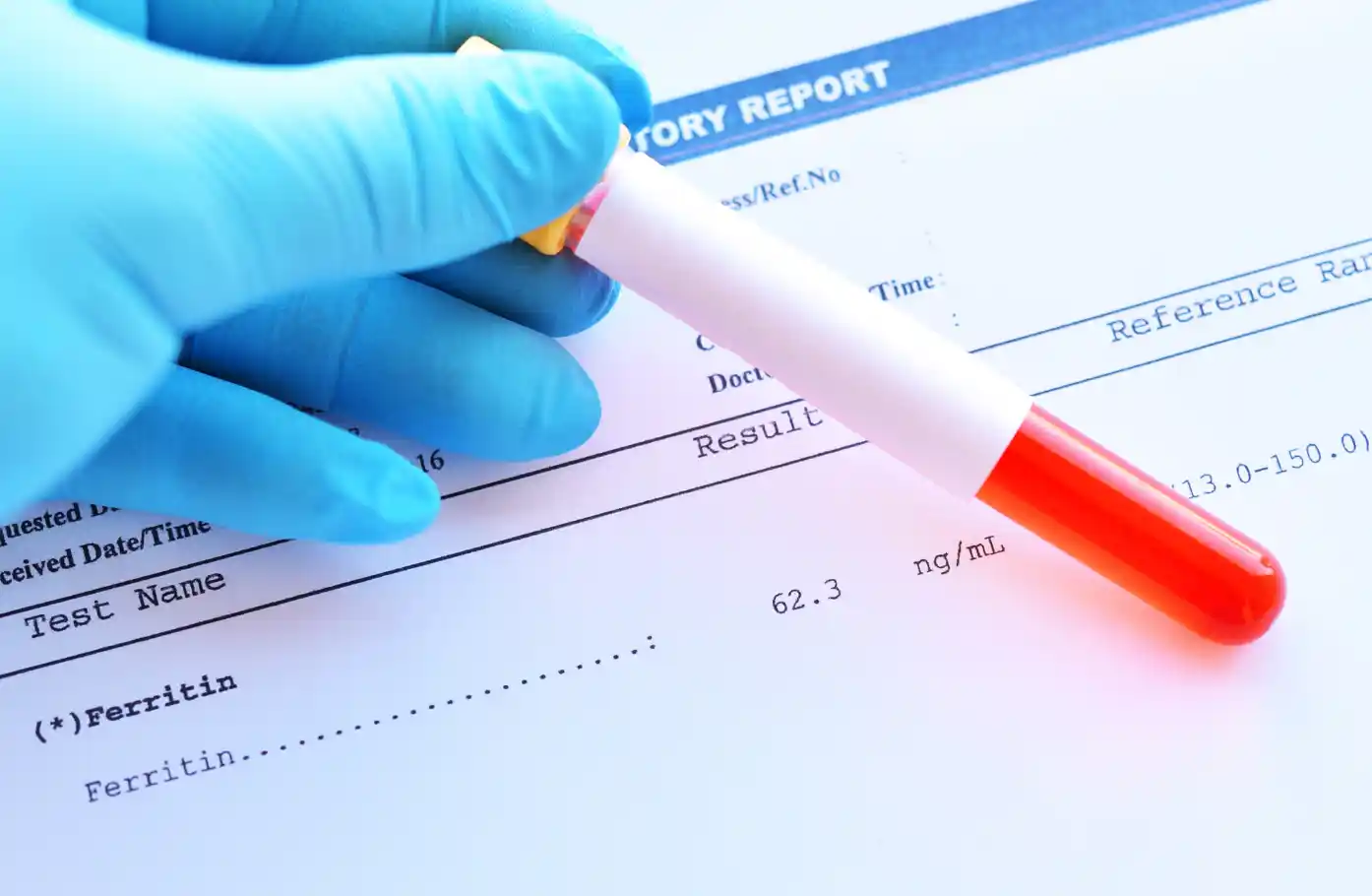
Many people experience this moment when checking lab results for hair loss:
The doctor glances at the report and says:
“Your hemoglobin is normal; this isn’t an iron deficiency issue.”
You breathe a sigh of relief and naturally assume:
“My iron must be fine, so the hair loss has another cause.”
But in reality, a significant portion of chronic, recurrent, and slow-recovering hair loss occurs in people who have:
Normal hemoglobin but low ferritin levels.
1. A Key Premise: Hemoglobin ≠ Ferritin
This is the core of the issue.
- Hemoglobin: Indicates whether there is enough iron currently available for oxygen transport and survival.
- Ferritin: Indicates whether the body has iron reserves that can be mobilized and allocated.
Think of it like money:
- Hemoglobin = money in your wallet (actively being used)
- Ferritin = savings in the bank (reserve you can draw from)
The body’s strategy is clear:
As long as hemoglobin is normal, even if reserves are low, survival systems won’t be compromised.
So, normal hemoglobin does not guarantee adequate iron reserves.
2. Why the Body Prioritizes Hemoglobin
Because maintaining hemoglobin is a survival-level priority.
When iron supply becomes limited, the body allocates in this order:
① Maintain hemoglobin first (oxygen, survival)
② Support immune and metabolic systems next
③ Finally, allocate to long-term growth tissues
Hair is among the first to be delayed or limited.
This leads to a common scenario:
“Everything seems fine, but hair keeps falling out.”
3. What Happens to Hair Follicles When Ferritin Is Low
Chronic low ferritin doesn’t mean follicles have no iron,
but that they enter a state of:
“Iron is scarce; it cannot be used freely.”
This leads to:
- Lower proportion of follicles entering the growth phase
- Ongoing growth phases ending prematurely
- Shortened and unstable growth cycles
The result is:
- Persistent hair shedding
- Slow new hair growth
- Thin, soft new hair that struggles to mature
This is not follicle damage, but a system-level restriction signal.
4. Why This Iron Deficiency Often Goes Unnoticed
It typically presents with:
- No obvious anemia symptoms
- Not necessarily dizziness, fatigue, or palpitations
- Daily life mostly normal
- Lab results that “look fine”
Internally, the body is quietly reducing non-essential expenditures.
Hair is often the first system to “signal an alert.”
5. Who Is More Prone to Low Ferritin Without Anemia?
The following situations increase risk:
- Long or heavy menstrual bleeding
- Pregnancy or postpartum recovery
- Long-term insufficient intake or dieting
- High stress or inflammation
- Reduced digestive or absorption efficiency
In these states, iron stores are gradually depleted, not suddenly lost.
6. Why Hair Doesn’t Immediately Improve After Iron Supplementation
This is crucial.
Low ferritin is not formed overnight, and short-term supplementation won’t instantly restore follicle trust.
The body needs confirmation that:
- Iron intake is stable
- There won’t be sudden interruptions
- Overall conditions are no longer critical
Until this confirmation occurs, hair follicle “growth permission” remains restricted, which is why iron-related hair loss recovery is slow, steady, and delayed.
7. Does This Mean Hair Loss Always Requires Iron Supplementation?
Not necessarily.
The relationship between ferritin and hair loss is a mechanistic understanding, not a self-diagnosis or treatment recommendation.
Iron metabolism is complex, and inappropriate supplementation can carry risks.
The purpose of this article is to help you understand:
- Why normal hemoglobin does not equal adequate iron reserves
- Why hair may be affected before other systems
It is not a substitute for professional evaluation.
8. Putting Ferritin in Its Proper Context
In nutrient-deficiency hair loss:
- Low energy → growth paused
- Low protein → growth quality limited
- Low ferritin → growth permission restricted
Ferritin is not the sole cause, but often a critical bottleneck in recovery progress.
Conclusion
If you are facing:
- Lab reports “look normal”
- Persistent hair shedding
- Unstable new hair growth
Remember: the body prioritizes survival over hair growth when resources are tight.
Understanding this is not meant to induce anxiety,
but to shift the responsibility from “I did something wrong” to “the body is making deliberate choices.”
In the next article, we will explore:
Why deficiencies in zinc, selenium, copper, and other trace elements affect scalp oils, inflammation, and hair stability — the fine-tuned signaling and barrier system after growth permission.