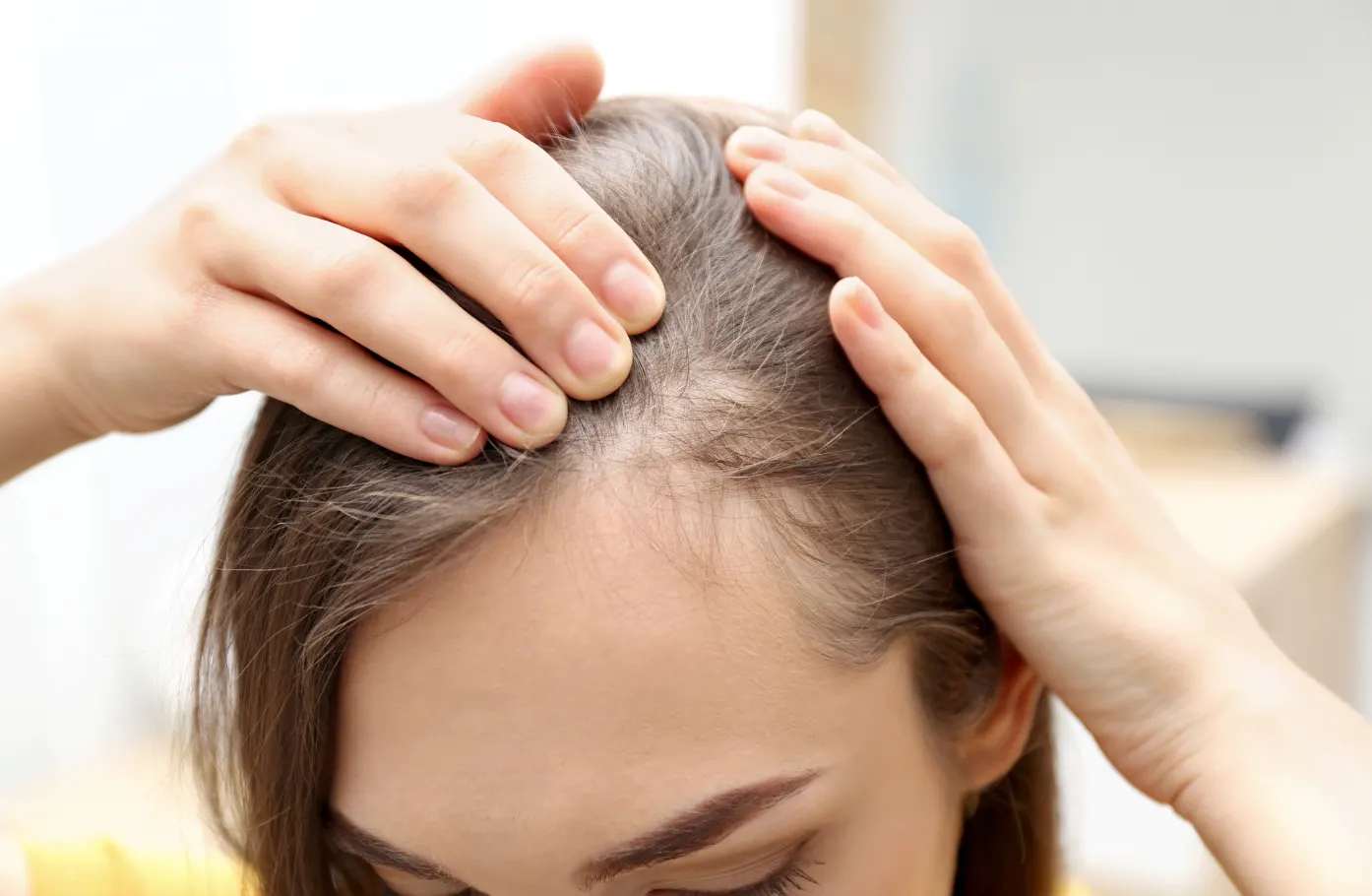
Why This Is One of the Most Common Causes of Hair Loss in Women
Among people experiencing nutrient deficiency–related hair loss, there is one background factor that appears extremely frequently, yet is rarely taken seriously: chronically heavy menstrual flow. For context on causes and risks, see Causes & Risks hub. Products to support recovery include Evavitae Root Fortifying Hair Essence.
When iron deficiency is mentioned, many women instinctively respond with:
“I’m not anemic.”
“My periods have always been like this.”
“A lot of people around me are the same.”
But the key issue is this—
“having always been this way” does not mean
“there is no physiological cost.”
I. A Critical Starting Point
Menstruation is not the problem.
The overlooked issue is long-term cumulative loss.
This article is not saying:
Menstruation is abnormal
There is something wrong with the female body
We are discussing a very specific mechanism:
when menstrual flow is consistently heavy, the body experiences a predictable—but often underestimated—loss of iron every month.
If this loss:
is not adequately compensated
or compensation efficiency is insufficient
iron stores can be gradually depleted without obvious warning signs.
Relevant reference: Long-Term Avoidance of Red Meat and B12 Risks
II. Why Is Chronic Blood Loss Easier to Overlook Than Acute Blood Loss?
Because it:
is not painful
is not sudden
does not disrupt daily life
There is no sense that “something is wrong.”
Yet physiologically, it is a persistent and repeatedly occurring source of loss.
A small amount each month—but over one, two, or five years—the difference becomes significant.
Hair is one of the systems most sensitive to reflecting this type of long-term imbalance.
See also: Iron Gaps in Women
III. Why Does Declining Iron Storage Affect Hair First?
Because iron in the body follows a very clear priority hierarchy.
When iron availability becomes limited, the body prioritizes:
hemoglobin production
oxygen transport
essential life-sustaining functions
Hair follicles belong to:
non-essential, deferrable, long-term growth systems.
As a result, even if:
hemoglobin remains within normal range
daily functioning appears unaffected
the “growth permission” of hair follicles may already be quietly reduced.
IV. Why Do Many Women Have Low Ferritin, Not Anemia?
This is one of the most typical—and most frequently misunderstood—patterns in female hair loss.
The reason lies in what each marker represents:
ferritin reflects iron storage
hemoglobin reflects current functional demand
The body will do its best to:
sacrifice storage to preserve immediate function.
This is why you may see:
lab results showing “no anemia”
while iron stores have been chronically low
Changes in hair are often one of the earliest outward signs of this ongoing depletion of reserves.
Reference: Poor Gut Absorption & Slow Hair Recovery
V. Why Does Heavy Menstrual Flow Easily Combine With Other Factors to Trigger Hair Loss?
A single factor does not always cause immediate problems.
In reality, chronic blood loss often coexists with:
relatively low protein intake (Low Protein Intake)
long-term stress or insufficient sleep (High Stress + Sleep Deprivation)
average or reduced digestive absorption efficiency (Low Stomach Acid & Poor Absorption)
high levels of physical activity (High Training Volume / Low Energy Availability)
a history of restrictive dieting (Long-Term Dieting)
When these factors overlap, the iron gap can widen rapidly. Hair is usually the first system affected.
VI. Why Is This Type of Hair Loss Usually Persistent Rather Than Sudden?
Because iron deficiency caused by chronic blood loss:
does not occur abruptly
accumulates gradually over time
As a result, hair loss often presents as:
persistent shedding
difficulty achieving full recovery
slow improvement even with intervention
You may feel:
“It seems like it’s always been shedding, but I can’t pinpoint when it started.”
VII. Why Is This Issue So Easily “Rationalized” by Women?
Because it is extremely common.
Many women have experienced it since adolescence (Adolescence & Rapid Growth)
Similar patterns exist among peers
It may not be flagged as abnormal in medical settings
As a result, it is often attributed to:
“my constitution”
“getting older”
“stress”
But within the framework of nutrient deficiency–related hair loss, this is a highly significant risk background.
VIII. Understanding This Is About Early Recognition — Not Self-Doubt
This point is essential.
Chronic blood loss does not mean you will inevitably experience hair loss.
It means that:
you rely more heavily than average on stable, long-term nutritional support.
The purpose of understanding this background is to:
stop attributing hair loss solely to hair care routines
avoid dismissing your own efforts
shift attention back to system-level factors
Summary
The higher incidence of hair loss in women is not because women are “more fragile,” but because long-term consumption is often underestimated.
If you:
have chronically heavy menstrual flow
experience persistent hair shedding
notice slow recovery
struggle to identify a clear cause
then within the nutrient deficiency–related hair loss framework, chronic blood loss and iron storage status are critical background factors worth considering.
This does not mean you did something wrong.
It is a reminder that:
some forms of loss are not dramatic—but they are continuous.