Among people experiencing nutrient deficiency–related hair loss,
long-term avoidance of red meat or animal-based foods is a fairly common background factor — yet one that is rarely discussed as a clear risk.
The reason is simple.
This pattern is often associated with:
A “healthier” dietary label
A strong sense of self-discipline
Clear personal or ethical choices
As a result, it is rarely linked to nutrient deficiency or hair loss.
From a physiological perspective, however, when red meat or animal-based foods are absent long term, the risk profile for iron and vitamin B12 does change.
This pattern sits within the broader Causes & Risks framework of nutrient-related hair loss (Causes & Risks Hub).
I. Clarifying the Position First
Dietary choices are not about right or wrong.
Risk discussion is not a rejection of those choices.
This article is not saying that:
Vegetarian or plant-forward diets are unhealthy
Avoiding red meat will inevitably cause problems
What we are discussing is this:
When certain key nutrient sources are consistently absent, the body becomes far more dependent on alternative sources and absorption efficiency.
If either of these becomes unstable over time, risk gradually emerges — a pattern explored in Why nutrient deficiency–related hair loss is not just about eating poorly
(Why It’s Not Just About Eating Poorly).
II. Why the Impact of “Red Meat Absence” on Iron Is Often Overlooked
Because iron does not exist in only one form.
In the diet:
Red meat primarily provides heme iron
Plant-based foods provide non-heme iron
The key differences are:
Heme iron follows a more direct absorption pathway
It is less dependent on gastrointestinal conditions
Its bioavailability is more stable
When red meat is absent long term:
Iron intake relies more heavily on non-heme iron
Absorption becomes more sensitive to factors such as
stomach acid
gut health
meal composition
The result is often this:
iron is consumed, but long-term usable iron is inconsistent — a mechanism discussed in depth in
Long-Term Avoidance of Red Meat or Animal-Based Foods: How to Rationally Assess Iron and B12 Risks.
III. Why Vitamin B12 Risk Is Even Easier to Miss
Because B12 deficiency develops slowly.
Vitamin B12 has several characteristics:
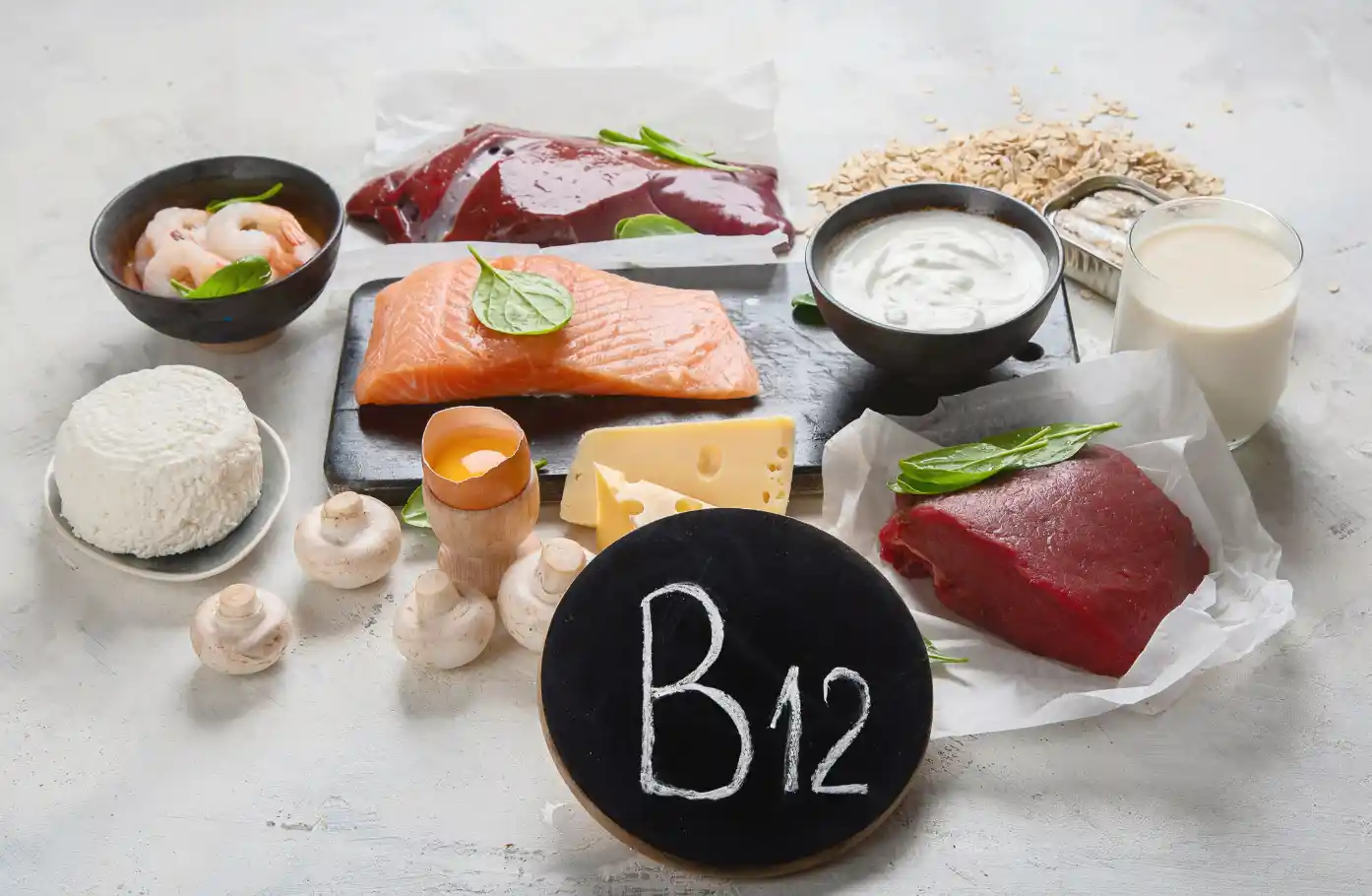
It is found almost exclusively in animal-based foods
The body maintains a certain level of stored reserves
Deficiency often takes years to become apparent
Many people go through a phase where:
They feel completely normal
Lab results appear “within range”
Daily functioning is unaffected
Meanwhile, over the long term:
Stored reserves are gradually depleted
Ongoing intake is insufficient to fully offset losses
Hair, as a system dependent on long-term metabolic stability, often reflects this imbalance earlier than other functions.
IV. Why These Risks Often Show Up in Hair
Because iron and B12 are not only “blood nutrients.”
In hair growth, they are involved in:
Cellular division efficiency
Regulation of the hair growth cycle
Long-term metabolic support
When supply becomes unstable, the body prioritizes:
The nervous system
The blood system
Basic metabolic functions
Hair follicles, meanwhile, quietly have their “growth priority” reduced.
Supportive scalp environments can help maintain follicle conditions during recovery phases, such as with
Evavitae Root Fortifying Hair Essence.
V. Why Risk Can Exist Even Without Being Vegetarian
Because real-life diets are rarely textbook-perfect.
Common patterns include:
Not vegetarian, but rarely eating red meat
Animal-based foods consumed only sporadically
Intentional avoidance for “light eating” or fat control
Long-term plant-heavy eating due to convenience
In these cases, the risk does not come from the choice itself, but from long-term structural absence — a pattern frequently observed in high-risk populations
(High-Risk Groups for Nutrient Deficiency–Related Hair Loss).
VI. What Background Factors Further Amplify Iron and B12 Risk?
When reduced red meat or animal food intake overlaps with:
Heavy menstrual bleeding or chronic blood loss
(Heavy Menstrual Bleeding & Iron Gaps)Already low protein intake
(Low Protein Intake & Hair Loss)Suboptimal digestive absorption
(Poor Gut Absorption & Slow Recovery)Chronic stress or insufficient sleep
(High Stress & Sleep Deprivation)A history of dieting or repeated fat loss
(Long-Term Dieting & Fat Loss)
Risk increases significantly.
Hair often becomes one of the earliest systems to reflect this cumulative physiological pressure.
VII. Why This Type of Hair Loss Tends to Develop Gradually
Because the deficit is progressive.
There is no sudden cutoff
No dramatic symptoms
The body is constantly operating in a “just enough” state
Hair changes therefore appear as:
Gradual reduction in density over years
Slower new growth
Thinner, softer hair strands
You may not recall a clear starting point, but you clearly feel:
“It’s been getting worse over time.”
VIII. Understanding Risk Is About Making Informed Choices
One point is crucial.
Recognizing iron and B12 risk does not mean abandoning dietary values.
It means understanding that long-term absence requires more deliberate management.
With this awareness:
You stop blaming yourself
You avoid over-attributing hair loss to products or stress alone
You begin evaluating structural nutritional completeness
Summary
Hair loss does not necessarily mean you are “eating poorly.”
Sometimes, it reflects the long-term absence of specific key nutrient sources.
If you:
Have avoided red meat or animal-based foods long term
Experience persistent hair loss with slow recovery
Or see limited response to supplementation
Then within the nutrient deficiency–related hair loss framework, the long-term availability of iron and vitamin B12 deserves focused consideration.
This is not an accusation.
It is a reminder:
Choices are valid — but long-term structure needs to be visible.