
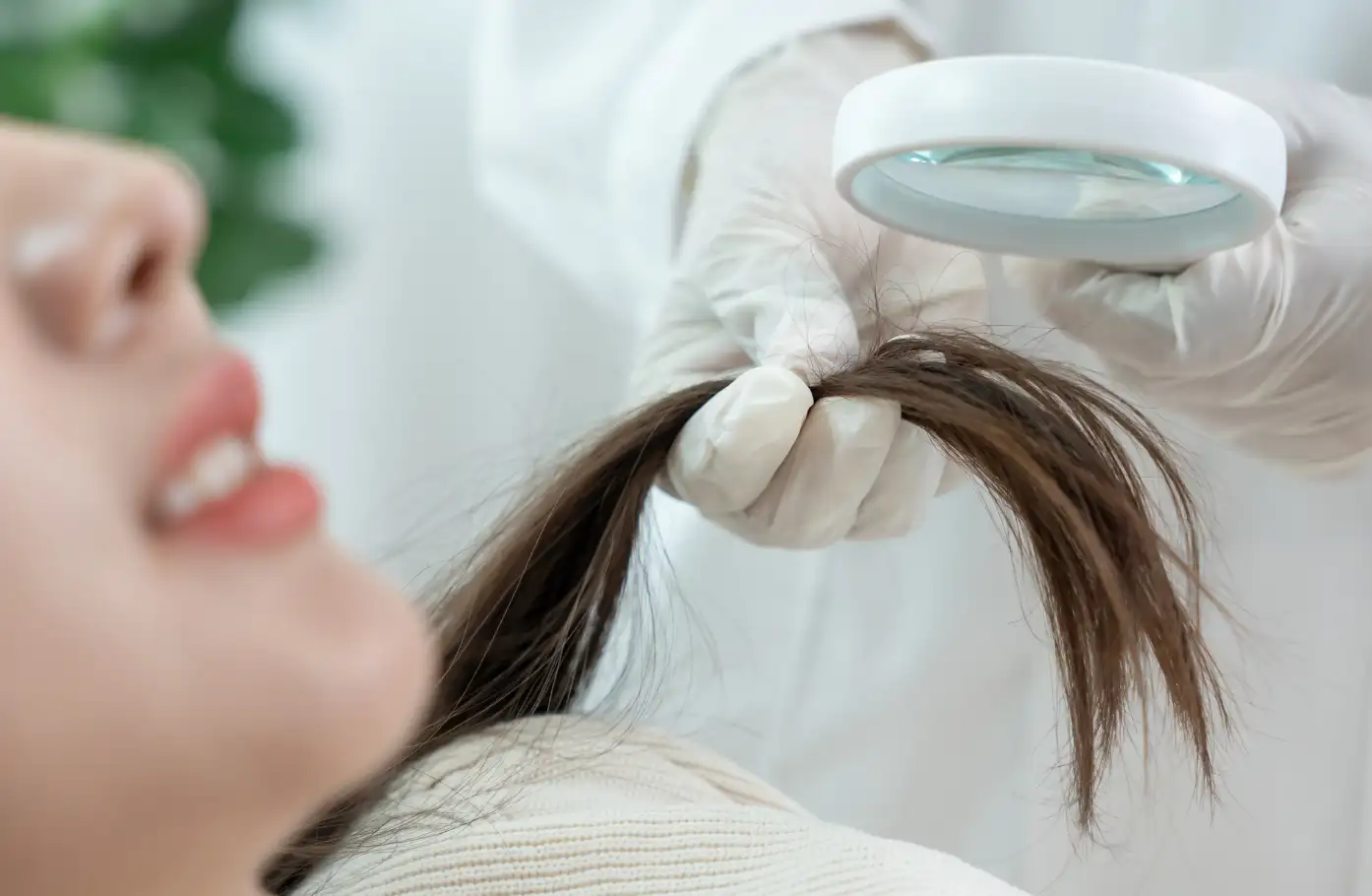
During the recovery process of nutrient deficiency–related hair loss, one of the most commonly misunderstood signs is this:
New hair “doesn’t look good enough.”
At this stage, many people experience intense doubt:
• “Why is it so thin?”
• “Why is it soft and unable to hold shape?”
• “Does this even count as recovery?”
But the reality is the opposite.
In nutrient deficiency–related hair loss, fine and soft new hair is often clear evidence that recovery has already begun.
For practical guidance, see the Recovery Journey hub and supportive products like Evavitae Root Fortifying Hair Essence.
I. First, Correct the Most Common Misconception
New hair ≠ mature hair
Every strand of hair, without exception, goes through a growth progression:
Thin → slightly thicker → mature
There is no such thing as:
• Hair that grows out thick and strong immediately
• Full-quality hair from the very beginning
If newly grown hair looks “perfect” right away, it is worth questioning whether the observation itself is accurate.
II. Why Is New Hair Almost Always Fine and Soft at the Start of Recovery?
Because when recovery has just been initiated, the body’s strategy is not full output — it is trial operation.
At this stage:
• Resources have just begun to be reallocated
• Growth signaling has only recently restarted
• Hair follicles are still testing environmental stability
As a result, new hair often shows these features:
• Smaller diameter
• Lighter color
• Softer texture
This is not a defect. It is a very typical activation pattern.
III. Why Is This Actually Good News?
Because it confirms three critical things:
• The follicle is still alive
• The growth phase has been reactivated
• The system has judged that growth is now possible
In nutrient deficiency–related hair loss, the truly concerning state is not “thin new hair,” but the complete absence of new growth.
IV. Why Do So Many People Misjudge This Stage as Failure?
Because many people use the wrong reference point.
They compare a recovering system to its historical best state.
This is especially common when:
• Looking at others’ before-and-after cases
• Comparing with old photos
• Anxiety levels are high
What gets overlooked is one key fact: you are not maintaining a peak state — you are rebooting a system.
V. Will Fine, Soft New Hair Stay Thin Forever?
In most cases of nutrient deficiency–related hair loss, the answer is no.
As long as:
• The foundation remains stable
• Nutrient gaps continue to be covered
• There is no repeated restriction or overexertion
Then:
• The same hair shaft gradually thickens
• Subsequent new growth improves in quality
• Overall density slowly increases
This process, however, always unfolds over months — not weeks.
VI. Why Does Rushing at This Stage Often Make Things Worse?
Because after noticing fine new hair, many people instinctively:
• Increase stimulation
• Frequently change approaches
• Begin anxiety-driven interventions
These behaviors send the body a signal: “The environment is unstable. Reassess risk.”
In response, follicles may:
• Slow growth again
• Delay further resource allocation
This is not because hair is “weak,” but because the system is recalibrating safety.
VII. How Should This Stage Be Viewed Correctly?
At Recovery Step 4, the focus should not be:
• “Is it thick enough yet?”
But rather:
• Is new growth continuing?
• Is density better than when there was none?
• Is the overall trend moving upward?
Trend always matters more than individual strand quality.
VIII. When Should You Actually Be Concerned?
Fine, soft new hair itself is not a problem.
Reevaluation is only needed if:
• New hair appears briefly and then disappears
• New growth is followed by another heavy shedding phase
• Restriction, high stress, or sleep disruption returns
In these cases, the issue is usually not the hair itself, but renewed instability in the foundation.
Summary
In nutrient deficiency–related hair loss recovery, “imperfect growth” is often proof that growth has begun.
If what you are seeing now is:
• Fine new hair
• Light-colored new hair
• Soft hair that does not yet hold shape
Do not rush to dismiss it.
On the correct recovery path, fine new hair is not the endpoint — it is the starting line.
For full context on recovery stages, refer to the Recovery Mechanism × Daily Actions Table.