
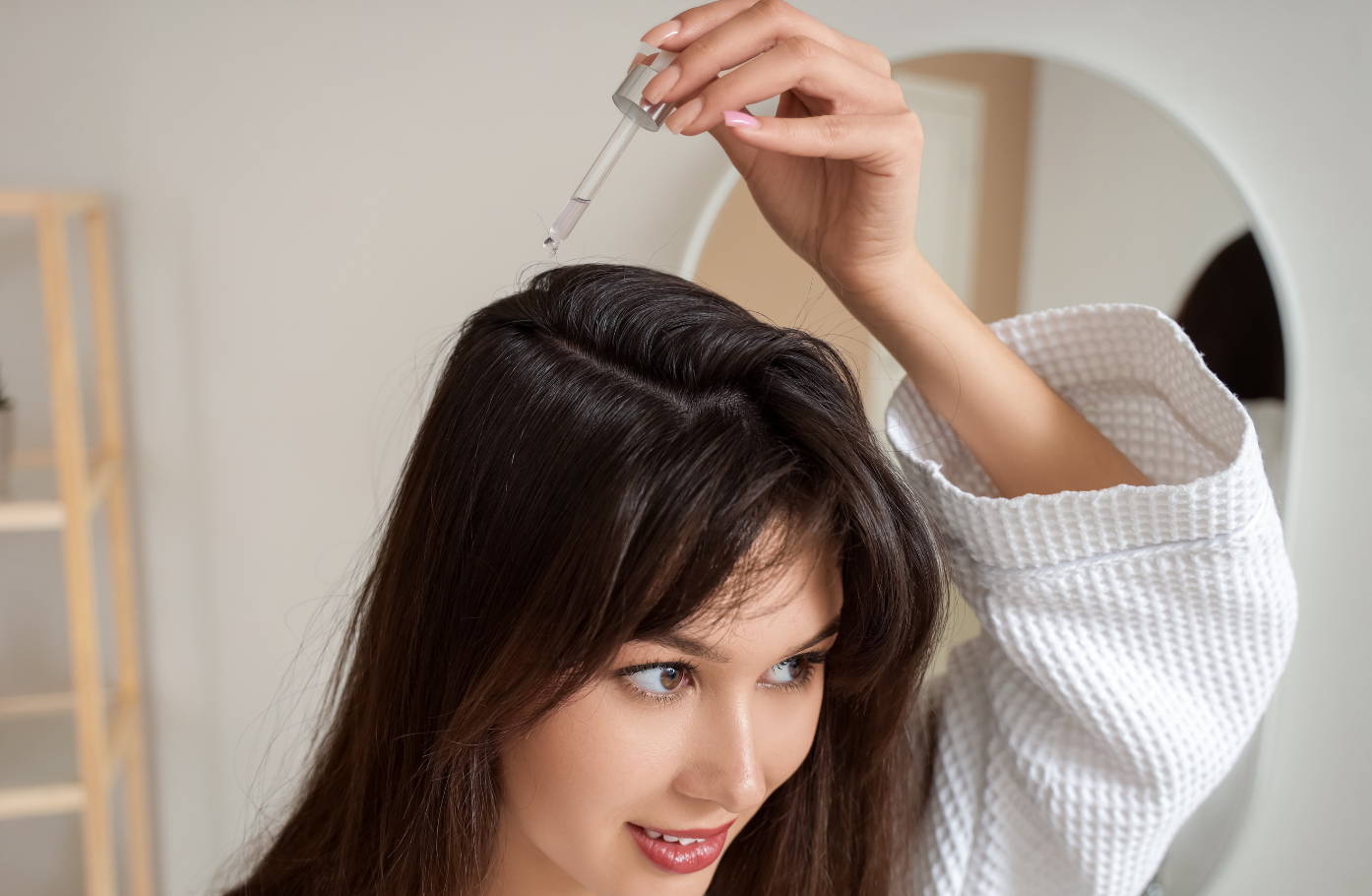
In hormonal hair loss, oil is often the most visible — and most anxiety-provoking — signal.
Flat hair.
Heavy roots.
Fast oil buildup.
It’s easy to reach a simple conclusion:
“Oil must be the problem.”
So care routines naturally shift toward:
- Stronger oil-removing products
- More frequent cleansing
- Lighter, more “refreshing” ingredients
But during hormonal fluctuation, this logic often pushes a temporary issue into a long-term pattern.
This misdirection is extremely common even in otherwise well-designed routines under hormonal hair-loss scalp care.
A Core Conclusion First
During hormonal phases, oil is not the real enemy — inflammation is.
Oil is a surface variable.
Inflammation is the underlying environment that determines follicle behavior.
If the inflammatory background does not settle:
- Follicles remain in a guarded state
- Growth signals stay suppressed
- Shedding becomes recurrent
And aggressive oil removal is one of the most common ways to extend inflammation instead of resolving it.
Why Oil and Inflammation Become Tightly Linked During Hormonal Fluctuation
Hormones Alter Sebum Quality and Rhythm
When hormones are unstable:
- Sebum production speed changes
- Sebum composition shifts
This means oil is not just “more” —
it becomes more likely to act as an irritant.
Inflammation Feeds Back Into Oil Production
Once inflammation is present:
- Sebaceous glands become more active
- Oil output increases further
A familiar loop forms:
Oil → inflammation → more oil → stronger cleansing → prolonged inflammation
This is why activation-focused approaches often fail when inflammation has not yet settled, as explained in follicle-activating ingredients: when they help — and when they backfire.
Why Aggressive Oil Removal Often Makes Things Worse
Over-Degreasing Damages the Barrier and Amplifies Inflammation
Strong oil removal strips:
- Protective lipids
- Barrier integrity
As a result:
- External irritants penetrate more easily
- Inflammation becomes harder to shut down
This is why barrier damage and sensitivity rise so frequently during hormonal hair loss — a pattern explored further in barrier repair: why sensitive scalps are so common in hormonal hair loss.
Harsh Oil Control Triggers Rebound Sebum Production
During hormonal fluctuation:
- Sebum feedback mechanisms are already unstable
Forcefully removing oil sends the signal:
“Oil is insufficient.”
The system responds by producing more — faster.
Inflammation Becomes “Locked In”
Repeated oil-stripping creates a state where inflammation:
- Never fully flares
- Never fully resolves
This low-grade, persistent state is particularly unfavorable for follicles.
What “Anti-Inflammation” Actually Means Here
Anti-inflammation does not mean:
- Erasing inflammation completely
- Using aggressive suppression
It means:
- Reducing duration and intensity
- Allowing the system to close the stress response naturally
In practical terms:
- Fewer new triggers
- More time for repair
- Letting inflammation resolve fully, not linger
This logic aligns with the broader principle that “gentle” is not marketing language, but a recovery requirement for sensitive scalps.
The Real Goal of Sebum Balance
Sebum balance does not mean:
- No oil
- Extreme dryness
- Constant “fresh” sensation
It means:
- Predictable oil rhythm
- Longer post-wash stability
- Fewer inflammation-triggered reactions
When oil stops acting as a trigger, follicles can gradually lower their guard.
A Critical Self-Check Question
Ask yourself:
If I stop intensifying oil control and maintain only gentle care, does my scalp gradually stabilize — or does it spiral out of control?
If the answer is gradual stabilization, your anti-inflammation direction is likely correct.
Why Anti-Inflammation and Sebum Balance Are Central Conditions for Recovery
Because they directly affect:
- Follicular sensitivity to hormones
- Tolerance to stimulation
- Ability to receive growth signals
When inflammation settles:
- Growth signals execute more easily
- Later ingredient choices are less likely to backfire
At this stage, even supportive formulations — such as Evavitae Root Fortifying Hair Essence — can function as intended, without adding new stress to the system.
Final Summary
During hormonal fluctuation:
- Oil is the outcome
- Inflammation is the decision-maker
Anti-inflammation is not “slower.”
It is the only path that does not repeatedly delay recovery.
Next, we move to a factor that is extremely common in hormonal hair loss
yet frequently overlooked:
Barrier Repair: Why Sensitive Scalps Are So Common in Hormonal Hair Loss