
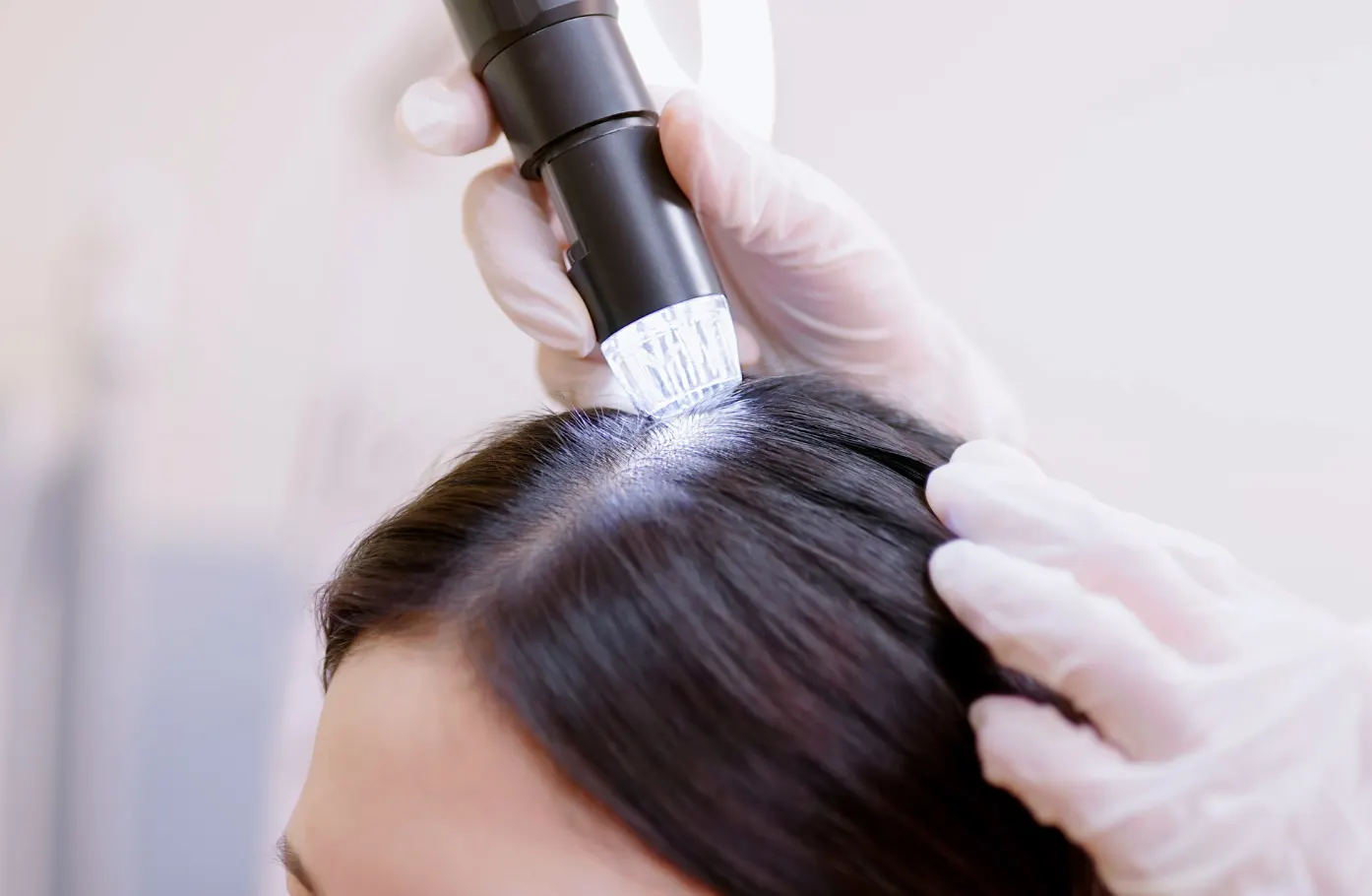
During nutrient-deficiency–related hair loss, the first noticeable change for many people is not increased shedding—but heightened scalp sensitivity.
This may show up as:
Shampoos that used to work now causing discomfort
Increased itching, tightness, stinging, or heat
A persistent feeling that the scalp is “tired,” even without excessive manipulation
These changes are often misinterpreted as:
Inadequate cleansing
Insufficient care
Products not being “strong enough”
But in reality, the underlying issue is often far more fundamental:
The scalp barrier is weakening.
For a full guide on nutrient-deficiency hair loss, see nutritional deficiency hub.
For scalp-focused routines, see Scalp Care & Routine.
For external support, see Evavitae Root Fortifying Hair Essence.
For managing micro-inflammation and barrier recovery, see scalp environment management.
1. Core Conclusion: Under Nutritional Deficiency, the Barrier Is Being Overdrawn
The scalp barrier is not an isolated structure. Its maintenance depends on:
Adequate energy availability
Stable nutrient supply
Ongoing self-repair capacity
When the body enters a state of nutritional deficiency, resource allocation naturally shifts toward systems essential for survival.
The scalp barrier is often one of the first areas where resources are reduced.
This is not a failure of your routine—it’s a sign that the body temporarily lacks the capacity to invest in “maintenance.”
For more on why scalp routines still matter even under nutrient deficiency, see why scalp routine still matters.
2. Why Does a Weakened Barrier Amplify Every Stimulus?
A healthy scalp barrier does not completely block external factors. Instead, it:
Regulates water loss
Buffers external irritation
Modulates the intensity of inflammatory responses
When the barrier is compromised:
Moisture escapes more rapidly
Irritants penetrate more easily
Nerve endings become more exposed
As a result, the same washing or care habits begin to feel far more uncomfortable.
This explains why, during nutritional deficiency:
Strong degreasing feels harsher (gentle cleansing guidance)
Hot water becomes intolerable
Frequent cleansing leads to increased itching
3. Why “Washing More” Often Makes the Barrier Worse
This is one of the most common—and easily misunderstood—responses.
When scalp discomfort appears, many people assume:
Oil isn’t being removed properly
Buildup is accumulating
Cleansing intensity needs to increase
So they wash more often and more aggressively.
But when the barrier is already fragile, this approach tends to:
Further disrupt lipid structures
Accelerate moisture loss
Trap the barrier in a cycle of incomplete repair and instability
The result is a frustrating loop:
The more you wash, the more sensitive the scalp becomes.
For more guidance on gentle cleansing and hair washing frequency, see hair washing frequency: how often is reasonable.
4. The Real Goal of Barrier Repair During Recovery
In nutrient-deficiency hair loss, the goal of barrier repair is not to:
Eliminate all sensation
Make the scalp immediately resilient
Instead, the true objective is to:
Reduce unnecessary resource consumption
Create a state where the body no longer has to “put out fires” repeatedly
When the barrier stabilizes:
Micro-inflammation resolves more easily
External stimuli stop stacking on top of each other
The follicular environment becomes more predictable
5. What Topical Strategies Actually Support Barrier Repair?
Barrier repair ≠ layering more active ingredients.
During nutritional deficiency, a more appropriate topical approach usually includes:
Gentle cleansing without aggressive oil stripping (gentle cleansing reference)
Simple formulations with fewer potential irritants
Stable usage patterns rather than frequent product changes
The goal is singular:
Reduce variables, so the scalp can gradually return to a self-regulating state.
For supporting topical science in nutrient-deficiency hair loss, see topical ingredients: what should they really do.
6. Why Does Hair-Loss Anxiety Often Decrease Once the Barrier Stabilizes?
As the scalp barrier begins to recover:
Signals like itching, stinging, and tightness diminish
Fear around washing and care decreases
The urge to constantly “try something new” fades
This leads to a crucial shift:
You stop creating new stress events for the scalp every day.
And in recovery, reducing stress is itself a form of progress.
For more on stress and supplement-related hair loss, see the supplement pitfall.
7. Putting Barrier Repair Back Into a Supporting Role
Barrier repair is not the main storyline—but it is the foundation that supports everything else.
When you shift the goal of topical care from “fixing the problem” to:
Stabilizing the state
Reducing ongoing loss
…you may find that:
Once the scalp stops holding recovery back, internal repair finally has room to unfold.
For internal nutrient support guidance, see overview of internal support.
8. One Sentence Worth Remembering
If you are experiencing nutrient-deficiency hair loss and notice increased scalp sensitivity, remember this:
This is not a sign that you’re cleansing too little—it’s the barrier asking for time to rest.
When you allow that stabilization to happen first, many seemingly complex issues begin to quiet down on their own.