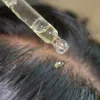

In hormonal hair loss, many people notice a distinct change:
- Products that once worked fine now feel irritating
- The scalp feels stingy, tight, stuffy, or uncomfortable
- Sensitivity to temperature, cleansing, and ingredients increases
It’s easy to reach one conclusion:
“Maybe I’ve become a sensitive type.”
But in most cases, this is not a sudden change in constitution.
It’s a sign that the scalp barrier has been under long-term strain.
This pattern appears frequently even in routines that otherwise follow hormonal hair-loss scalp care principles.
A Core Conclusion First
In hormonal hair loss, sensitivity is a state, not a fixed trait.
When hormones are stable, the scalp barrier has enough capacity to:
- Repair itself
- Buffer stimulation
- Maintain tolerance
During hormonal fluctuation:
- Repair speed slows
- Stimulation thresholds drop
- The barrier is repeatedly interrupted
That’s when people notice:
“What used to be fine suddenly isn’t.”
This doesn’t mean you’ve become weaker.
It means the system load has reached its limit.
What Is the Scalp Barrier — and Why Does It Matter So Much?
The scalp barrier is not an abstract concept. It includes:
- The structure of the stratum corneum
- Sebum and moisture balance
- The scalp’s microbial defense
Its core function is simple:
to keep external stressors out of the system.
When the barrier is intact:
- Ingredients are safer
- Stimulation is filtered
- Inflammation is less likely to activate
When the barrier is compromised:
- The same ingredient becomes irritating
- The same routine carries a higher cost
This is why safety and tolerance — not stimulation — are the first recovery requirements for sensitive scalps.
Why the Barrier Is Especially Vulnerable During Hormonal Hair Loss
Hormones Directly Affect Barrier Renewal
Changes in estrogen and progesterone influence:
- Keratinocyte turnover rhythm
- Lipid synthesis
During fluctuation:
- New barrier formation slows
- Existing barrier layers break down more easily
Overcompensation in Care Repeatedly Interrupts Repair
Driven by anxiety, many people stack:
- Strong cleansing
- Oil stripping
- Exfoliation
- Activating ingredients
These actions aim to “fix the problem,” but repeatedly interrupt the barrier just as repair begins.
This is why follicle-activating ingredients often backfire when introduced before the system is ready.
Inflammation Makes Barrier Repair Harder to Complete
Low-grade, chronic inflammation:
- Consumes repair resources
- Narrows the tolerance window
A familiar loop forms:
Barrier damage → sensitivity → more stimulation → delayed repair
This loop is closely tied to imbalanced sebum and unresolved inflammation during hormonal phases.
Why “No Stinging” Doesn’t Mean the Barrier Is Healthy
This point is often overlooked.
In hormonal hair loss:
- Barrier damage does not always cause obvious discomfort
You may only notice:
- Faster oil buildup
- Increased shedding
- Shorter stability periods
But for the system, these are clear signs that buffering capacity has declined.
The Real Position of Barrier Repair in the Recovery System
Barrier repair is not:
- A bonus step
- An optional upgrade
It is the safety valve for all other care actions.
When the barrier is compromised:
- Anti-inflammation is harder to complete
- Activating ingredients backfire more easily
- Cleansing balance becomes unstable
A Critical Self-Check Question
Ask yourself:
If I stop adding new interventions and maintain only the most basic, gentle routine for 2–3 weeks, does my scalp become more stable — or more uncomfortable?
If stability improves, your system is likely waiting for a repair window.
Why Barrier Repair Can Make Recovery Look “Slower”
Because the signals of barrier repair are subtle:
- Fewer flare-ups
- Less back-and-forth
- More predictable states
It does not immediately produce:
- Visible regrowth
- Faster results
But it ensures that everything that follows is no longer constantly interrupted.
During this phase, managing perception and confidence also matters, which is why hair fiber repair and visual density management play a role during recovery — even though they do not alter follicle biology.
Final Summary
In hormonal hair loss:
- Sensitivity does not mean you are fragile
- It means the system is asking for protection — not stimulation
As the barrier gradually recovers, you’ll often notice:
- Ingredients feel easier to tolerate
- Care routines stabilize
- Recovery finally stops resetting itself
Supportive, low-interference formulations — such as Evavitae Root Fortifying Hair Essence — are designed to respect this repair window rather than compete with it.
Next, we move into a very real — though non-physiological — dimension of recovery:
Hair Fiber Repair: Managing Visual Density (and Why This Matters During Recovery and Live Demonstrations)