
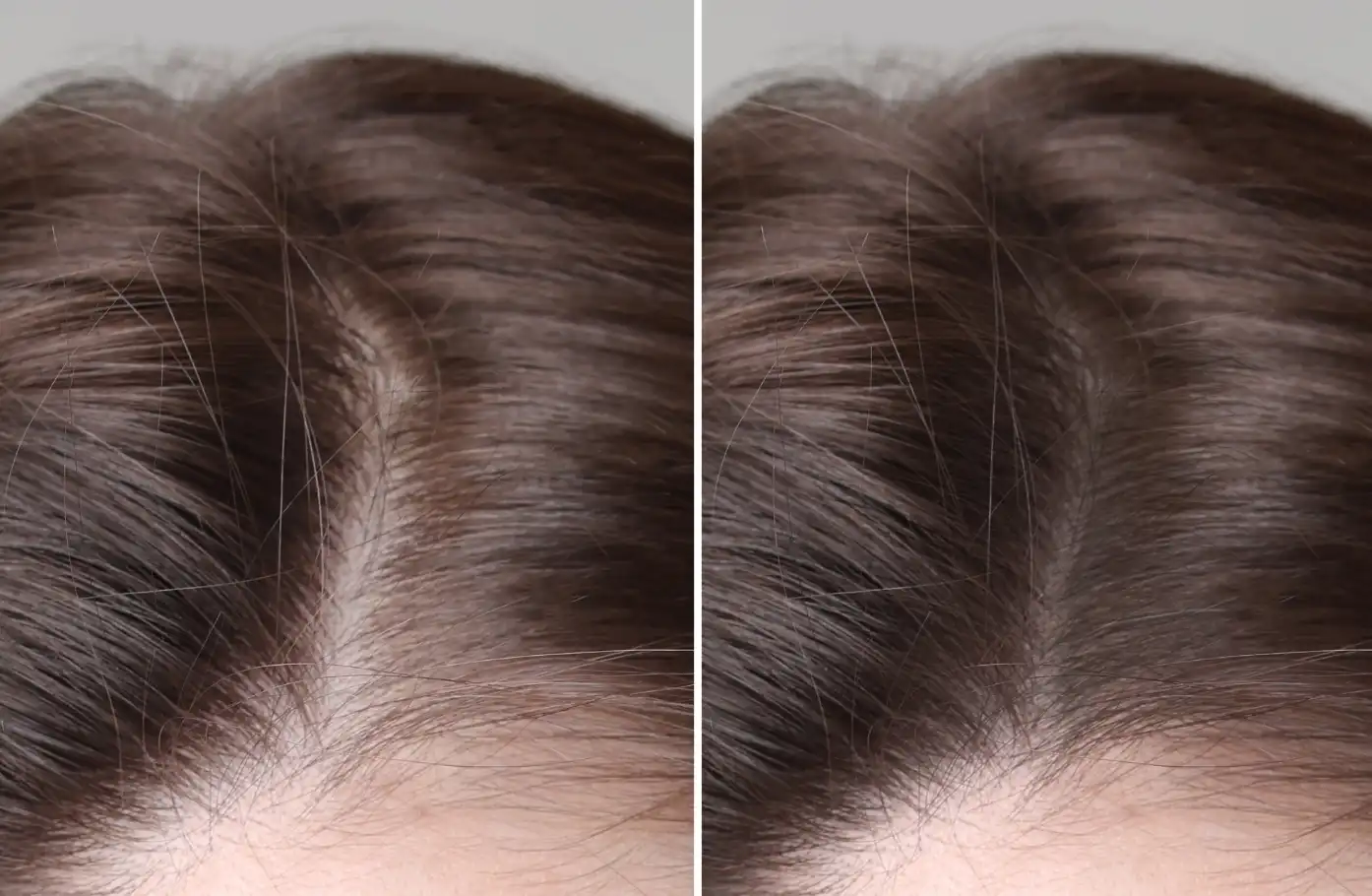
Many Women Misunderstand the Timeline
Many women start a regrowth routine with one expectation:
If new hair grows, density should come back quickly.
So when they notice baby hairs but still see a wider part line, thinner ponytail, or more scalp show-through, they assume something is wrong.
But here’s the truth:
Hair regrowth and density recovery are not the same process. They operate on different timelines — and they look different in real life. Understanding this difference is one of the most important steps in staying calm, staying consistent, and avoiding over-treatment during recovery. For context on what hair regrowth really means for women, see our cornerstone article.
What Hair Regrowth Really Means
Hair regrowth simply means this:
Follicles are re-entering the growth phase and producing new hairs again. That’s it.
Regrowth is a biological restart. It can happen even when your hair still looks thin overall, because early regrowth often begins under the surface and appears subtly.
What regrowth often looks like (especially for women)
Fine, soft hairs near the hairline or part
Short “flyaway” strands that don’t match the rest of your length
Uneven distribution (some areas restart earlier than others)
Periods where shedding still happens while new hairs begin
Regrowth is real progress — but it is not the same as fullness.
What Density Recovery Actually Means
Density recovery means:
Your overall hair mass and visual coverage return toward baseline.
That involves more than starting growth. It requires:
enough follicles restarting over time
those new hairs maturing (thickening and lengthening)
multiple growth cycles adding “layers” back into your hair
Even if regrowth begins today, density won’t “show” until the new hairs:
grow long enough to contribute coverage
thicken over time (new hairs mature gradually)
accumulate across cycles (one cycle rarely restores everything)
This is why women often feel stuck even when recovery is underway.
For details on why hair doesn’t regrow immediately and follicle cycling, see our related article.
The Timeline Mismatch That Creates Most Anxiety
Most women expect this timeline:
New hair → thicker hair → full hair
But biology usually looks like:
Stability → regrowth → maturation → density
A realistic way to think about it:
Regrowth is the system turning back on
Density is the result of time + accumulation
You can have strong regrowth and still have poor density for months. That doesn’t mean failure — it means you’re early.
Why Regrowth Can Be Happening Without Visible Density Change
Even when follicles restart, density may lag for several reasons:
New hairs start thin by default: Early regrowth hairs are often finer because follicles don’t “snap back” to full output instantly. Thickness can improve over time as the follicle stabilizes.
Length matters as much as count: A 1–3 cm new hair contributes almost nothing to ponytail volume or scalp coverage compared with longer hair.
Not all follicles restart at once: Regrowth is rarely synchronized. Some follicles re-enter growth earlier, others later. That creates the common “patchy” or uneven feeling even in diffuse shedding patterns.
You may still be shedding older telogen hairs: Regrowth and shedding can overlap. Older hairs completing their cycle can still fall while new ones begin. This overlap can make density look unchanged for longer than expected.
For more about follicle states, see dormant vs dead hair follicles.
Why Chasing Density Too Early Can Slow Recovery
The emotional response to slow density is often “do more”:
stronger actives
more stimulation
more frequent changes
aggressive scalp treatments
But early recovery is a fragile phase. Overloading the scalp can:
increase irritation or inflammation
disrupt barrier repair
create a stress response that delays growth signaling
If regrowth is a “permission process,” then pushing harder can send the opposite message:
“It’s still not safe.”
Supporting recovery with gentle products, like Evavitae Root Fortifying Hair Essence, helps maintain scalp stability during this critical early phase.
What to Measure Instead of Density in the Early Phase
If you only measure fullness, you’ll feel like you’re losing—even when you’re improving.
Better early indicators:
Shedding trend over time (not day-to-day): Look for a gradual reduction in “high shed days,” not perfect stability.
Scalp stability: Less itch, less tightness, less soreness, less reactivity.
New hair presence: Fine hairs count. Uneven hairs count. Soft hairs count.
Directional improvement: Recovery often comes in waves. The question isn’t “is it perfect?” It’s “is it trending better over weeks?”
How to Support Both Regrowth and Density (Without Panic)
You don’t need two separate strategies. You need one strategy with the right expectations.
Support regrowth with stability:
gentle, consistent cleansing
barrier-friendly routine
avoiding over-stimulation
reducing inflammatory background (scalp + lifestyle factors)
Support density with time and consistency:
stay consistent long enough for hairs to mature
avoid routine-hopping (it resets your ability to assess progress)
focus on long-term maintenance rather than short-term “boosts”
Density recovery is a slow build — not a switch.
The Reframe That Helps Most Women Stay Consistent
If you remember one thing, make it this:
Regrowth is the restart. Density is the accumulation.
So if you see new hairs but don’t feel fullness yet, that’s not a contradiction.
It’s exactly how recovery works.
Final Thoughts
Hair regrowth and density recovery are connected, but they are not the same event.
Regrowth can begin quietly and look underwhelming at first.
Density is what happens after regrowth has had time to mature, layer, and stabilize.
If you’re early in your journey, your job is not to force density.
Your job is to protect the process long enough for density to return. For a full guide on hair regrowth for women, see our cornerstone resource.