
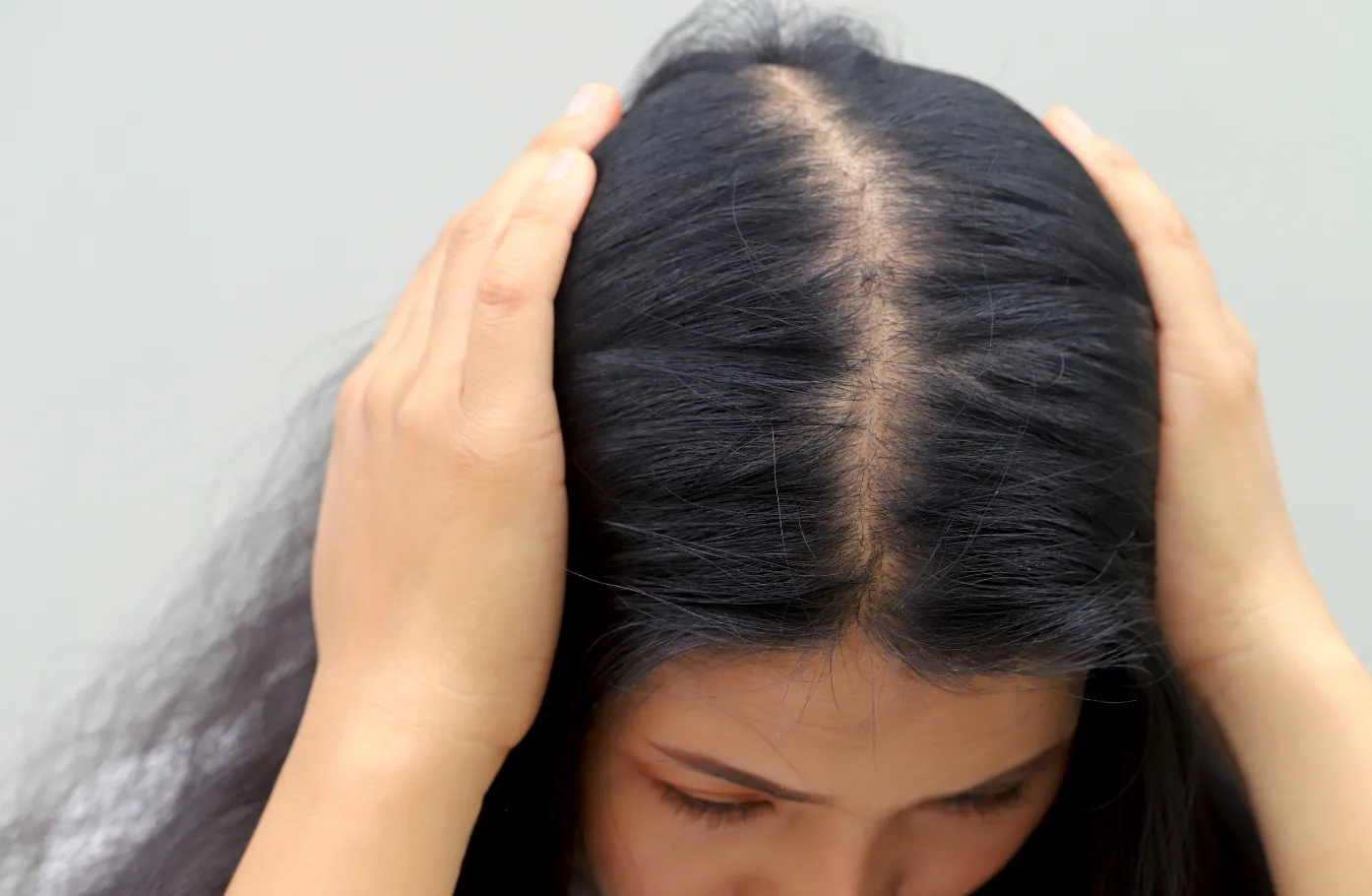
After you complete the first step of recovery— your hormonal signals begin to stabilize and stop swinging dramatically— most people naturally move into the next expectation:
“Does this mean new hair should start growing now?”
But in hormonal hair loss recovery, what truly determines whether regrowth can become stable is not how fast you “activate growth.”
It’s the growth environment.
If the scalp environment has not been rebuilt yet, even if new hairs appear, they can easily become:
- soft and weak
- slow-growing
- shedding soon after they emerge
- unable to enter a stable growth phase
That’s why—
👉 Step Two of hormonal hair loss recovery must be: stabilize the scalp first.
Why Scalp Stability Is a Step You Cannot Skip in Hormonal Hair Loss
Many people unconsciously treat scalp issues as “surface-level” problems, thinking:
Hormones are in the bloodstream.
The scalp is just external care.
But from the follicle’s real working environment, the truth is almost the opposite:
👉 Every hormonal signal is ultimately received and carried out inside the local scalp–follicle environment.
If the scalp has been stuck in a long-term state of:
- sebum imbalance
- recurring inflammation
- a weakened barrier
- microbiome disruption
Then even if hormonal signals have started to settle—as described in Step One: stabilizing the signals —follicles will often reach the same conclusion:
Now is still not the time to invest resources into growth.
Why New Hair “Can’t Stand” When the Scalp Is Unstable
In early recovery, many people notice “hope signals,” such as:
- fine baby hairs appearing
- small areas where new hairs start to pop up
But soon, they also notice:
- those new hairs don’t last
- density doesn’t truly come back
The reason is not that follicles “lack ability.”
It’s this:
👉 The scalp environment is still sending a risk signal to the follicles.
Under this condition, follicles often respond by:
- starting growth → then terminating early
- keeping the growth phase extremely short
- producing lower-quality new hair
So recovery can feel like:
“It looks like it started… but it didn’t really start.”
This pattern is especially common when recovery timing is misunderstood across different pathways.
Why Many People Try to “Fix the Scalp” and End Up Making It Less Stable
This is one of the easiest places to go off track in Step Two.
When shedding starts to ease but regrowth isn’t stable yet, many people rush to “improve the scalp” by doing things like:
- frequent exfoliation
- aggressive oil control
- constantly switching shampoos and treatments
- chasing instant freshness and volume
But to a recovering scalp, this often means:
- the barrier keeps getting interrupted
- the microbiome never has time to re-form
- low-grade inflammation quietly persists
The result is:
The scalp may look “clean” on the surface, but it never becomes stable underneath.
And that directly extends the recovery timeline—something that becomes clearer when viewed through a recovery mechanism × timeline map.
What It Actually Looks Like When the Scalp Starts Stabilizing
“Stable” does not mean:
- zero oil
- no itch or flakes ever
- instant perfection
In hormonal hair loss recovery, scalp stability is more about trend-level changes:
- oil production becomes more predictable
- less recurring stinging, tightness, or burning
- comfort after washing lasts longer
- tolerance for products improves
All of these changes point to one thing:
👉 The scalp is regaining its ability to self-regulate.
These signals often appear before visible regrowth and require daily actions that support—not disrupt—the current recovery mechanism.
Why “New Hairs Falling Out Again” Is Often Misread as “I’m Not Recovering”
At this stage, the most common misinterpretation is:
“New hairs fell out = I’m not in recovery.”
But a more accurate interpretation is:
👉 You are already in the recovery channel—but the scalp hasn’t fully caught up yet.
If you rush to add stimulation at this stage—
- strong massage
- high-stimulation actives
- frequent anti-dandruff or oil-control treatments
—you’re more likely to interrupt the stability you just started to build.
This is also why what looks like failure may actually be the system completing an earlier cycle.
What Step Two Is Really Trying to Achieve
It is not:
- immediate density
- fast length
- quick visual change
It is:
- lowering the inflammation background
- giving the barrier and microbiome time to rebuild
- creating a low-interference environment for new hair to grow
Gentle, consistency-based support—such as a root fortifying hair essence —is designed to assist this phase without overriding the scalp’s recovery rhythm.
When these conditions are met, the quality and survival rate of new hair gradually improves.
A More Important Metric Than “Is It Growing?” — The Survival Rate of New Hair
In Step Two, instead of repeatedly checking:
- do I have baby hairs?
- is it growing fast?
Watch a more reliable signal:
👉 Can the new hair stay?
When the scalp truly stabilizes, you’ll notice:
- far fewer new hairs dropping out
- fine baby hairs gradually thickening
- the growth phase starting to lengthen
That is the real sign recovery is moving forward.
Before Moving Into Step Three, Confirm This One Thing
Before expecting “obvious density return,” ask yourself:
- Is my scalp more tolerant than before?
- Are fluctuations clearly reduced?
- Are new hairs starting to “hold”?
If the answers are slowly becoming “yes,” then you’ve completed Step Two of hormonal hair loss recovery.
In the next article, we’ll enter a stage that is both commonly misunderstood and highly anxiety-provoking:
Because before follicles can enter a stable growth phase, they must first fully complete the previous cycle.