
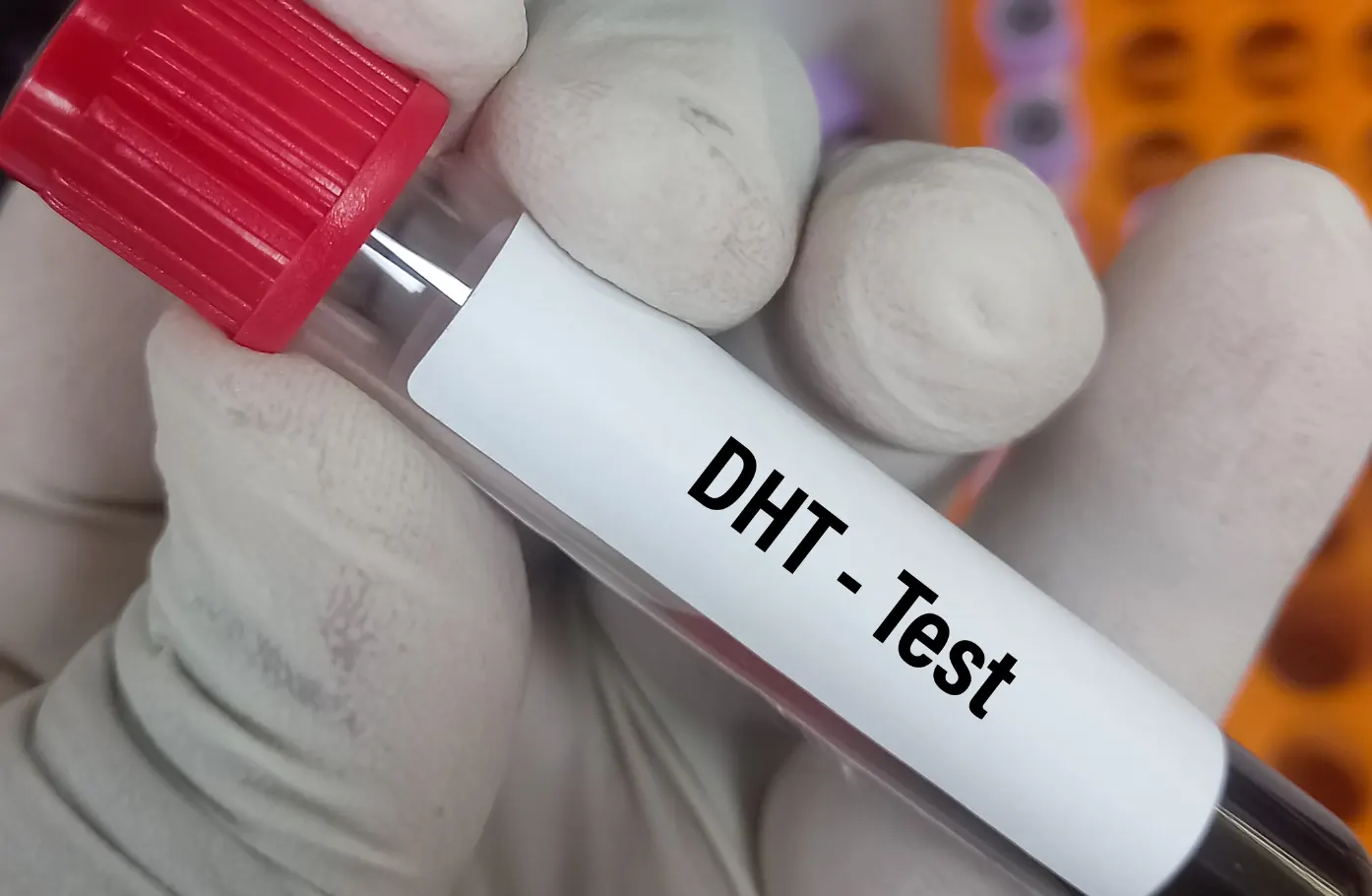
Among all explanations of hormonal hair loss, DHT (dihydrotestosterone) has almost become a universal scapegoat.
You’ve probably seen statements like these countless times:
- “Hormonal hair loss means high DHT.”
- “Hair falls out because DHT attacks follicles.”
- “As long as you suppress DHT, the problem is solved.”
So the issue gets quickly reduced to one sentence:
“Fix DHT, and everything will be fine.”
But it is precisely this oversimplification that causes many people to end up with more complexity, more imbalance, and more instability the longer they treat.
A Conclusion That Must Be Clarified First
DHT is a participant — not the sole cause
In hormonal hair loss,
DHT does play an important role.
But it functions more like:
an amplifier, not a trigger button.
This means:
- DHT is rarely the starting point
- its impact depends heavily on the surrounding system
- its significance changes at different stages
When everything is blamed on DHT, the deeper variables that actually determine the course of hair loss are often overlooked.
This misunderstanding is closely related to another common error: assuming normal hormone tests rule out hormonal hair loss.
Why the “DHT Narrative” Is So Appealing
Because it satisfies three powerful psychological needs.
It Provides a Clear Villain
Compared to complex systems, a single culprit feels reassuring.
It Offers a Seemingly Direct Solution
Suppress it.
Block it.
Lower it.
The logic feels simple, and the path looks clear.
It Comes With Ready-Made Products and Solutions
From medical treatments to hair care marketing,
DHT is an extremely easy concept to package and sell.
The problem is — simple does not mean correct.
Why Hair Can Still Fall When DHT Isn’t High
Because in many real-world cases, what actually changes is not the DHT value itself, but the following.
Increased Follicular Sensitivity to DHT
Even when DHT levels are within a normal range:
- follicles may respond more intensely to the signal
- the growth phase can be interrupted more easily
- the resting phase may be prolonged
This is a local sensitivity issue, not a systemic hormone excess.
The System Environment Amplifies DHT’s Effect
Under conditions such as:
- chronic stress
- elevated inflammatory background
- disrupted sleep and circadian rhythm
- unstable blood sugar or metabolism
the same level of DHT can be interpreted by the system as:
“This is not a safe time for growth.”
Hair loss follows — even though DHT itself is not the root cause.
DHT Is Often the Final Link, Not the First
In many pathways, the sequence looks more like this:
- system instability develops
- follicular tolerance decreases
- signal regulation becomes impaired
- only then does DHT’s inhibitory effect become evident
In this sense, DHT acts more like an executor after instability, not the original decision-maker.
This is also why people often feel confused after weeks of effort, asking why they’re still shedding after several weeks of treatment.
Why Focusing Only on DHT Narrows the Path
Once you conclude that:
“Everything is a DHT problem,” your strategy often becomes:
- relentless suppression
- constant escalation
- neglect of tolerance and rhythm
But in hormonal hair loss, over-suppression itself is a risk.
Especially during:
- perimenopause
- PCOS-related hair loss
- periods of compounded stress
A single-track approach can easily create new imbalances.
This pattern is often reinforced by the belief that stronger growth ingredients automatically mean better results.
A Crucial Distinction to Make
DHT-related does not mean DHT-dominated
Hormonal hair loss is indeed related to DHT.
But that does not mean:
- DHT is the only variable
- every stage should revolve around it
- lower is always better
A more accurate understanding is this:
DHT’s impact depends on whether the system is stable and whether follicles are allowed to grow.
When Targeting DHT Actually Makes Sense
Usually only when:
- overall system stability has improved
- inflammation and rhythm are under control
- shedding trends are no longer wildly fluctuating
At that point, DHT can be considered a supporting regulatory factor.
Not a sole breakthrough strategy when the system is still unstable.
A Healthier Way to Evaluate the Situation
Instead of asking:
“Is this a DHT problem?”
Try asking:
- Is my system under long-term stress?
- Do my follicles have enough tolerance?
- Is growth suppressed by the signal itself — or by the environment?
If the environment does not permit growth, even very low DHT will not initiate recovery.
This is also why broader context matters more than isolated data points, and why checking hormones alone is often insufficient.
One Thing You Truly Need to Let Go Of
If you’ve ever:
- panicked because of DHT narratives
- searched endlessly for “stronger suppression”
- pinned all recovery hope on a single number
please know this:
You didn’t misunderstand the problem.
You were trapped inside an overly simplified story.
Final Takeaway
In hormonal hair loss:
- DHT is one variable
- not the only cause
- and not the central target at every stage
Compressing a complex system into a single “villain” may feel efficient — but it usually comes at the highest cost.
This understanding belongs within the broader Mind & Myths framework (https://www.evavitae.com/hormonal-hair-loss-myths/).
For many people, shifting attention back to stability and tolerance — including gentle supportive scalp care — helps create the conditions where regulation can actually occur.
Next, we’ll return to the care layer and examine one of the most common — and most “obvious” — mistakes of all: