
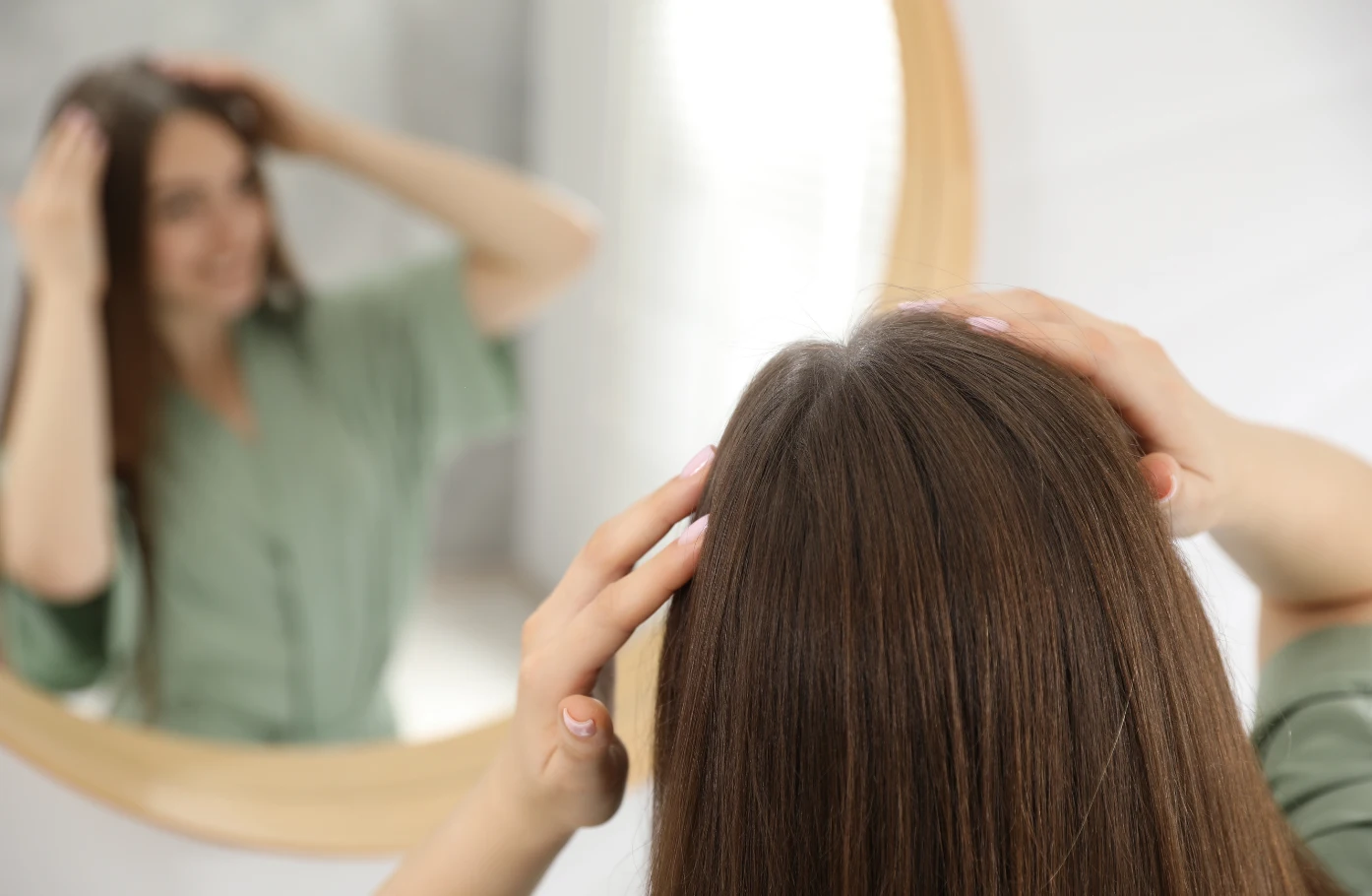
Many people experiencing nutritional deficiency–related hair loss have a moment where an undefined shame arises.
It’s not because anyone is blaming you,
but because inside, you silently judge yourself:
“I’m shedding so much again — did I do something wrong?”
Hair shedding stops being just a physical phenomenon
and instead becomes a judgment of your actions, discipline, or even character.
This misinterpretation can be more hurtful than the shedding itself.
1. When Do Body Signals “Go Wrong”?
Initially, shedding is simply information:
The body is under stress
Resources are limited
The system is adjusting
But once you repeatedly hear, see, or compare advice,
the signal gradually takes on “meaning”:
More shedding = not recovering
More shedding = doing something wrong
More shedding = not disciplined / not consistent enough
Suddenly, the body’s response becomes moralized.
You’re no longer observing,
you’re silently enduring judgment.
2. Why Nutritional Deficiency Hair Loss Is Especially Prone to Moralization
It hits three psychological high-risk points:
① Strong association with “choices”
Food intake, supplementation, and lifestyle are seen as things you can control.
Therefore, outcomes are naturally attributed to your choices, even though the reality is far more complex.
② No clear external “responsible party”
Unlike illness, accidents, or side effects,
nutritional deficiency hair loss has no obvious “enemy.”
Responsibility quietly shifts onto yourself.
③ Repeated, ambiguous, and delayed feedback
When a problem is recurrent and feedback is delayed,
the mind instinctively searches for meaning.
Moral judgment is often the easiest explanatory framework.
3. What Happens When Hair Shedding Becomes “Judgment”?
It leaves three subtle, damaging effects:
① Loss of basic trust in your body
You stop seeing your body as a self-regulating system.
Instead, it becomes something:
“constantly exposing my failures.”
You may become hyper-alert, suspicious, or even hostile toward it.
② Overinterpreting normal fluctuations
Phenomena that should be understood as:
Cycle variations
Stress responses
Normal ups and downs
…are magnified into:
“I’m ruined.”
“I’ve regressed again.”
Anxiety comes not from change itself, but from the moral interpretation of change.
③ Difficulty practicing gentle recovery
When shedding = failure,
it’s hard to allow yourself to:
Slow down
Relax
Prioritize stability over intensity
Gentleness is misread as indulgence under this logic.
4. A Critical Misconnection to Break
Hair shedding ≠ you did something wrong
Shedding only shows one thing:
the body is processing previous conditions according to its own schedule.
It does not indicate:
Effort level
Discipline
Worthiness of recovery
Assigning moral meaning to it is essentially using the body to punish the mind.
5. True Recovery Begins With “Demoralization”
This is not empty advice.
When you stop treating body signals as judgment:
You more easily accept fluctuations
You no longer feel the need to prove anything
You allow the system to recover gradually
A body that feels safe is willing to cooperate —
especially in nutritional deficiency–related hair loss.
6. What to Do If You’re Already Trapped in This Logic
You don’t need to immediately change all your thoughts
or force yourself to be “positive.”
Next time hair sheds, try reframing:
Not: “Did I do something wrong again?”
But: “This is my body processing a state it previously endured.”
Even if you don’t fully believe it yet,
simply not punishing yourself immediately allows recovery to start moving forward.
For additional support, you can use Evavitae Root Fortifying Hair Essence to gently reinforce scalp health during this phase.
7. The True Purpose of This Article
It’s not just to “cheer you up.”
It’s to put body signals back in their proper place:
they are information, not judgment.
When hair shedding no longer equals failure,
you can finally break the cycle:
Self-blame → Control → Anxiety → Going off track.
For more insight on common misconceptions about nutritional deficiency hair loss, explore our Mind & Myths hub: Nutritional Deficiency Hair Loss Myths.