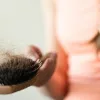

During the recovery process of nutrient deficiency–related hair loss, many people reach a stage where several things seem to be in place:
• The metabolic and energy foundation has been restored
• Nutrient gaps are being filled
• New hair has already begun to grow
Yet at the same time, a new problem appears.
New hair breaks easily, sheds easily, grows slowly, or keeps repeating without accumulating.
At this point, the issue is often no longer about whether nutrition is sufficient, but rather whether the scalp environment has truly entered a state of stability.
For context, see the Recovery Journey hub and supportive products like Evavitae Root Fortifying Hair Essence.
I. A Core Conclusion to Establish First
Hair growth is not a single event.
It is a continuous project.
Growing one strand of hair is not difficult.
What is difficult is keeping it alive and growing over the following months in an environment that consistently supports growth — the scalp.
II. What Does “Scalp Stability” Actually Mean?
Here, “stable” does not mean completely oil-free, flake-free, or itch-free.
It means:
• An intact barrier function
• Low levels of inflammation
• Relatively orderly sebum production
• A microenvironment without extreme fluctuations
In simple terms, the scalp is no longer frequently entering a stress response.
III. Why Does Unstable Scalp Environment Affect New Hair First?
Because new hair has three inherent characteristics:
• Fine diameter and incomplete structural maturity
• High sensitivity to environmental changes
• Low resistance to disturbance
When the scalp is in conditions such as:
• Chronic inflammation
• Sebum imbalance
• Barrier damage
The body receives a signal again: “The local environment is unstable. Resource investment should be cautious.”
As a result, the first to be affected is often the hair that has just started to grow.
IV. Why Can’t Scalp Stability Be Bypassed Even with Good Nutrition?
This is where many misunderstandings occur.
Nutrition determines: whether resources are available
The scalp environment determines: whether those resources can be continuously utilized.
If the scalp remains unstable for long periods:
• Inflammation consumes local energy
• Barrier repair competes for resources
• Growth signals are repeatedly interrupted
This is why some people see nutrient markers improve while hair remains fragile and inconsistent.
V. What Signs Suggest the Scalp Is Holding Recovery Back?
During the mid-recovery phase, if you notice several of the following at the same time:
• New hair appears repeatedly but fails to accumulate
• Shedding worsens noticeably with stress or schedule changes
• The scalp feels itchy, tight, oily, or prickly
• Seasonal changes or late nights trigger strong reactions
The issue is often not renewed nutrient deficiency, but a scalp that has not yet entered stable operation.
VI. Why Does the Scalp Often Feel More Sensitive During Recovery?
Because recovery is a transition from conservation to rebuilding.
During this period:
• Sebaceous gland rhythms are being recalibrated
• The barrier is repairing itself
• The scalp microbiome is reorganizing
These processes naturally increase sensitivity to stimulation.
This is also why, during recovery, aggressive interventions tend to cause more problems rather than fewer.
VII. The Core Logic of Truly Stabilizing the Scalp
The goal is not zero oil or zero flakes.
The key principles are three words: Gentle + Consistent + Predictable
• Gentle: Avoid repeated irritation
• Consistent: Do not change approaches frequently
• Predictable: Allow the scalp to adapt to a regular rhythm
When the scalp can anticipate what comes next, stress responses naturally decrease.
VIII. Why Is Scalp Stability Critical for Preventing Relapse?
In nutrient deficiency–related hair loss, relapse rarely begins with nutrition.
A more common pathway looks like this:
Stress or schedule disruption → Scalp instability → New hair fails to stay → Increased shedding → Amplified anxiety
Once scalp stability is strong enough, even temporary fluctuations are less likely to cause the hair to be abandoned entirely.
Summary
In nutrient deficiency–related hair loss recovery, nutrition determines whether hair can grow, but the scalp determines whether it can stay.
If you have already:
• Started seeing new hair
• Noticed overall improvement
• Yet feel that growth cannot be maintained
Then the next step may not be adding more nutrients, but asking an honest question: Has my scalp truly entered a stable operating state?
For overall recovery timelines, see Nutrient Deficiency–Related Hair Loss Recovery Timeline and Recovery Mechanism × Daily Actions Table.