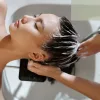

Why people instinctively overdo scalp care during stress hair loss
When stress-related hair loss begins, many people share the same uneasy thought:
“Am I doing enough?”
When shedding continues or recovery feels slow, this question quickly turns into action.
Care routines start to pile up:
- More massage
- More exfoliation
- More devices
- More oils
- More treatments with obvious sensations
The underlying belief is simple:
If I do more, recovery will come faster.
But stress hair loss does not behave like that.
In reality, what it fears most is not lack of effort, but excessive effort.
For an overview of what stress hair loss is — and why recovery depends on safety rather than stimulation — see stress-related hair loss fundamentals.
A core recognition you must establish first
During stress hair loss recovery, the scalp is not in a resilient, tolerant state.
It is in a high-sensitivity, high-alert state.
This means:
- Nervous system thresholds are lower
- Immune and inflammatory responses are more easily amplified
- Even mild stimulation may be interpreted as potential danger
📌 So the true goal of scalp care at this stage is incredibly specific:
To keep the scalp feeling continuously safe, stable, and predictable.
Anything that disrupts that perception can quietly delay recovery — even if it feels proactive.
For a hub-level guide to building a stable recovery approach specifically for the scalp, visit stress hair loss scalp care.
Why “gentle” is actually the more advanced form of care
Many people equate advanced care with doing more.
But biological recovery does not measure effort the way humans do.
What determines whether follicles continue growing is not:
- How many tools you use
- How many steps you apply
- How intense the method feels
What matters is whether the body is willing to maintain investment.
And the body decides this based on one key question:
“Is this environment likely to remain stable?”
That’s why:
- ✅ Gentleness = low fluctuation
- ✅ Restraint = predictability
- ✅ Absence of strong sensation = safety
These signals perfectly align with what stress hair loss recovery needs most.
The most common “overexertion logic” in scalp care
Before we talk about what works, we need to clear away what doesn’t.
During recovery, many people unconsciously rely on the following assumptions:
- “If it hurts a little, it must be effective.”
- “If it tingles or heats up, something is happening.”
- “If I can feel it immediately, it’s not a waste of time.”
But in the context of stress-related hair loss, these sensations often mean only one thing:
👉 The nervous system has been pushed back into alert mode.
And once alert mode returns, recovery mechanisms slow down almost instantly.
If you want the product-selection version of this same “avoid stimulation logic,” see choosing hair care products during stress hair loss recovery.
What truly recovery-friendly scalp care looks like
1️⃣ Gentle touch — not force
If you include scalp massage in your routine, remember this principle:
The purpose of massage is relaxation, not activation.
This means:
- Use finger pads, not nails or tools
- No scraping, pressing, or pain
- No goal of “deep stimulation”
A simple rule helps here:
📌 If your scalp feels tighter after care than before, you went too far.
The correct sensation is subtle:
“Comfortable while doing it, calmer afterward.”
2️⃣ Low frequency matters more than high intensity
Stress hair loss recovery responds best to:
- Infrequent
- Repetitive
- Familiar actions
Not to:
- Constant novelty
- Daily upgrades
- Pressure to intensify
Hair follicles are conservative by nature.
They prefer what they recognize over what feels new.
📌 Familiarity builds safety faster than novelty ever could.
This principle is part of a larger pattern where stability over time matters more than perfect choices, explained in care rhythm during stress hair loss recovery.
3️⃣ The scalp should feel “quiet” after care
A surprisingly reliable evaluation method is this:
Good scalp care does not demand your attention afterward.
If after care you experience:
- Heat
- Pulsing
- Urges to touch or check
- Hyper-awareness
Then the care likely introduced stimulation rather than stability.
In recovery, forgetting about your scalp is often a better sign than feeling it strongly.
The correct role of products in scalp care
Products should support the scalp’s recovery — not test its limits.
✅ Gentle shampoo: the foundation of scalp stability
Your shampoo is the product your scalp is exposed to most frequently.
It quietly determines:
- How often the scalp barrier is challenged
- Whether daily cleansing feels safe or stressful
- Whether washing maintains calm or creates tension
During stress hair loss recovery, a gentle shampoo serves as the base layer of care.
For example, if you are using a formula like Evavitae’s gentle anti–stress hair loss shampoo, its purpose is very specific:
- Cleanse without over-stripping
- Leave the scalp relaxed, not tight
- Turn hair washing into a predictable, non-threatening action
📌 This may feel “basic,” but it is one of the most important recovery supports.
For a detailed explanation of why cleansing frequency should not be driven by fear, see the truth about cleansing during stress hair loss recovery.
✅ Hair growth oil: support, not awakening
Hair oils in recovery are often misunderstood.
They are not mandatory.
They are stage-dependent.
More appropriate signs for introducing them include:
- Clearly reduced shedding
- Absence of persistent tightness or itching
- Early but consistent regrowth
At this point, a growth-support oil plays a gentle role:
- Supporting microcirculation
- Providing stable lipid nourishment
- Reducing friction and dryness
A formulation like Evavitae Hair Growth Oil is designed for support, not stimulation.
📌 No strong sensations are required for it to be useful.
For timing guidance on when it’s appropriate to introduce stronger layers of support, see when you can safely upgrade care during stress hair loss recovery.
✅ Hair masks: reducing mechanical stress is also scalp care
Hair masks are often dismissed because they “don’t grow hair.”
That’s true — but incomplete.
During recovery:
- New hair is finer
- Hair strands are softer
- Mechanical pulling becomes easier
Reducing friction and tension helps lower overall stress signals reaching the scalp.
A repair-focused mask like Evavitae FortiRepair Mask helps by:
- Improving slip and manageability
- Reducing tugging during washing and brushing
- Making the overall routine calmer and easier
This indirect relief matters more than many people realize.
Why gentleness aligns with later recovery stages
As recovery progresses:
- Follicles are already active
- New growth is underway
At this stage, the system becomes more vulnerable to disruption, not less.
That’s why many people plateau or relapse after initial improvement:
They mistake momentum for permission to intervene harder.
📌 In stable recovery phases, support beats intervention.
This broader “system readiness” concept is also connected to internal recovery mechanisms, explained in does stress hair loss require internal recovery — yes, but not in the way most people think.
A simple decision formula
If a scalp care method makes you:
- More anxious
- More focused on results
- More inclined to check
Then it is likely not optimal for your current recovery stage.
Even if it’s popular.
Even if it feels “professional.”
Even if it worked for someone else.
One-sentence conclusion
During stress hair loss recovery, the most advanced scalp care is not about adding more.
It is about keeping the nervous system from raising its guard again.
When the scalp is truly calm, hair follicles are far more willing to stay and keep growing.
For a gentle, recovery-stage supportive option that fits this “quiet stability” principle, see Evavitae Root Fortifying Hair Essence.