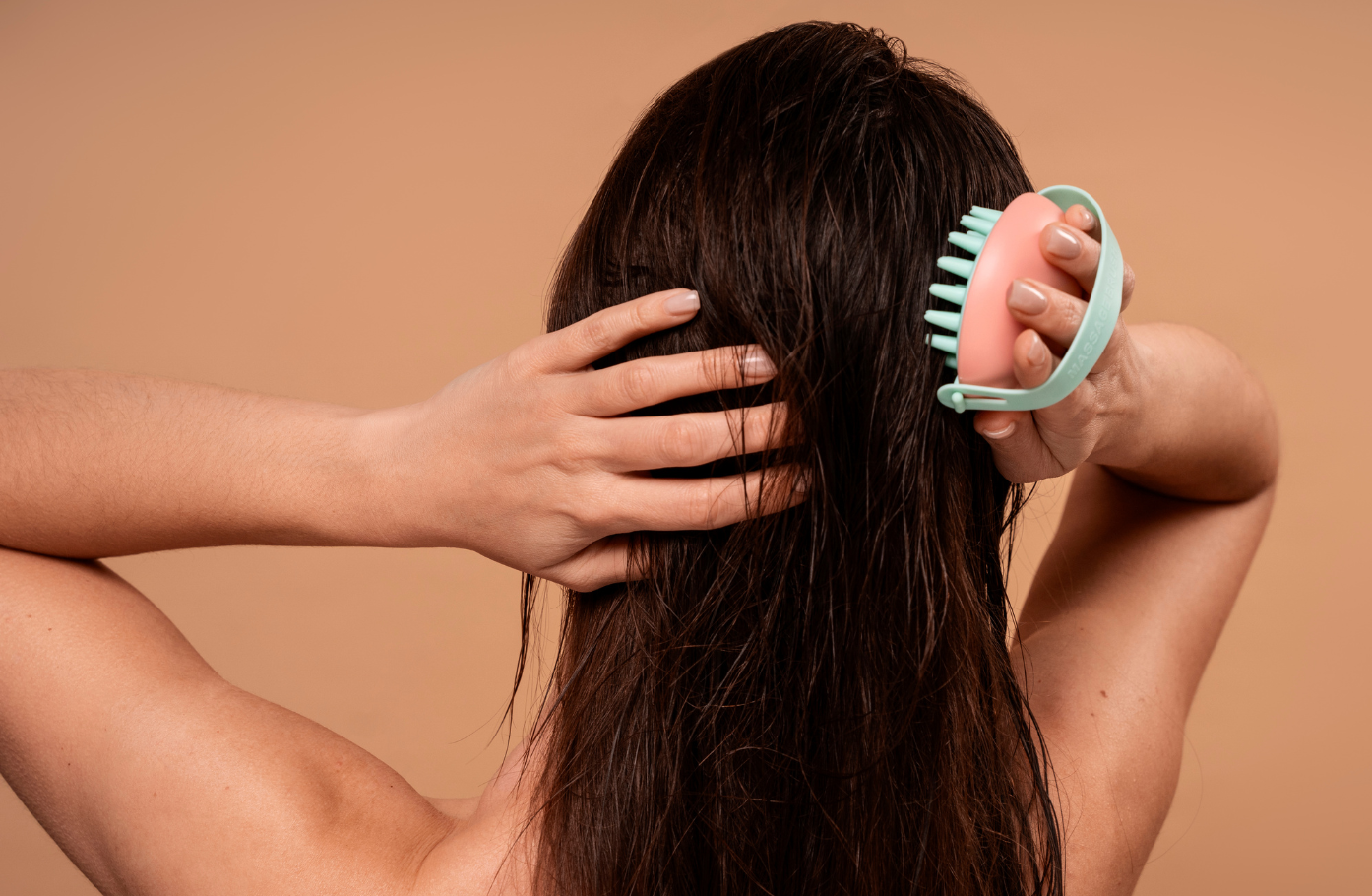
During hormonal hair loss care, scalp massage is often the step people place the highest expectations on.
Common questions sound like:
- “If I massage more, will my hair grow faster?”
- “I massage for 20 minutes every day — why am I still shedding?”
- “Am I not pressing hard enough?”
These questions themselves reveal a key misunderstanding:
A condition-based action is being treated as a result-driven solution.
Scalp Massage Is Not a “Start Button” — It’s a Preparation Step
Here is the core conclusion first.
In hormonal hair loss, whether a follicle enters the growth phase depends on a system of conditions:
- Whether hormonal signals allow growth
- Whether inflammation has settled
- Whether the scalp environment is stable
- Whether energy and nutrients are available
Scalp massage cannot independently change these conditions.
What it can do is this:
When conditions are gradually aligning, massage helps allowed recovery happen more smoothly.
This distinction is central to hormonal hair-loss scalp care, where most delays come not from lack of effort, but from mispositioned effort.
What Scalp Massage Actually Supports
When applied correctly, scalp massage mainly supports three layers.
Local Circulation and Metabolic Efficiency
Massage can help:
- Improve local microcirculation
- Support the removal of metabolic byproducts
But it does not create blood flow on its own.
It can only optimize efficiency when the system already allows circulation support.
If inflammation and oil-driven stress remain unresolved, circulation gains are often short-lived — which is why scalp environment management that reduces sebum and inflammation first is a prerequisite for massage to show value.
Nervous System Relaxation Signals
In hormonal hair loss, a chronically elevated sympathetic nervous state is common.
Gentle, rhythmic massage:
- Sends a “safety” signal to the nervous system
- Helps the body step out of prolonged stress response
This is highly supportive for recovery — but it remains background regulation, not direct hair growth stimulation.
Massage works best when daily care already avoids overstimulation, including strong cleansing that backfires during oily phases and hormonal fluctuation.
Scalp Tissue Mobility
Under long-term tension and inflammation:
- Scalp tissue mobility decreases
- Follicles become mechanically “fixed” in unfavorable conditions
Massage can:
- Slightly improve tissue glide
- Reduce local stiffness
Again, this is condition optimization, not stimulation.
If massage is layered on top of unstable routines — such as washing too infrequently during sebum fluctuation — its effects are often masked or misread.
Why Trying to “Massage Hair Back” Almost Always Fails
In hormonal hair loss:
- Follicles enter resting phases
not because stimulation is insufficient
- But because the system temporarily does not permit growth
Under this background:
- Increasing pressure
- Extending massage time
- Raising frequency
Often leads to one of two outcomes:
- No visible effect → frustration
- Excess stimulation → increased shedding
This is also one of the most common pathways through which mechanical damage creates false worsening in hormonal hair loss.
This is why many people conclude:
“Scalp massage doesn’t work for me.”
In reality, it’s not useless — it’s simply being used with the wrong expectation and position.
What “System-Friendly” Massage Looks Like
In hormonal hair loss, effective massage follows three principles.
Gentle
- No chasing soreness, pain, or heat
- No pulling or tugging on hair
Brief
- A few minutes is sufficient
- Long, repetitive sessions are unnecessary
Rhythmic
- Stable, predictable movements
- A relaxed mental state
This type of massage supports both the scalp environment and the nervous system.
Supportive leave-on products, such as Evavitae Root Fortifying Hair Essence, are designed to work with this gentle rhythm — not amplify stimulation during massage.
A Crucial Self-Check Question
Ask yourself one question during massage:
Do I feel more relaxed — or more anxious and impatient for results?
If massage becomes:
- A task to complete
- A form of self-monitoring
- Proof that “I’m trying hard enough”
Then its supportive value may already be cancelling itself out.
When Does Scalp Massage Start Showing Its Value?
Usually when these signs begin to appear:
- Shedding fluctuations become smaller
- Scalp stability periods lengthen
- No clear irritation reactions are present
At this stage, massage functions as:
a lubricant for a system already moving toward recovery — not a force dragging the system into growth.
Care factors like heat exposure also matter here, as the scalp becomes more sensitive to heat during perimenopause and sebum fluctuation, further narrowing the safe stimulation window.
Why Scalp Massage Deserves Its Own Explanation
Because it is the step most likely to be overdone:
- It feels safe
- It’s easy to perform
- It creates a strong sense of effort
But in hormonal hair loss, effort applied in the wrong direction often extends recovery time.
Final Summary
In hormonal hair loss:
- Scalp massage is not a hair-growth technique
- It is a condition amplifier
When placed correctly:
- No chasing results
- No escalation
- No anxiety
It becomes a quiet but meaningful support to the system — instead of another source of pressure.