
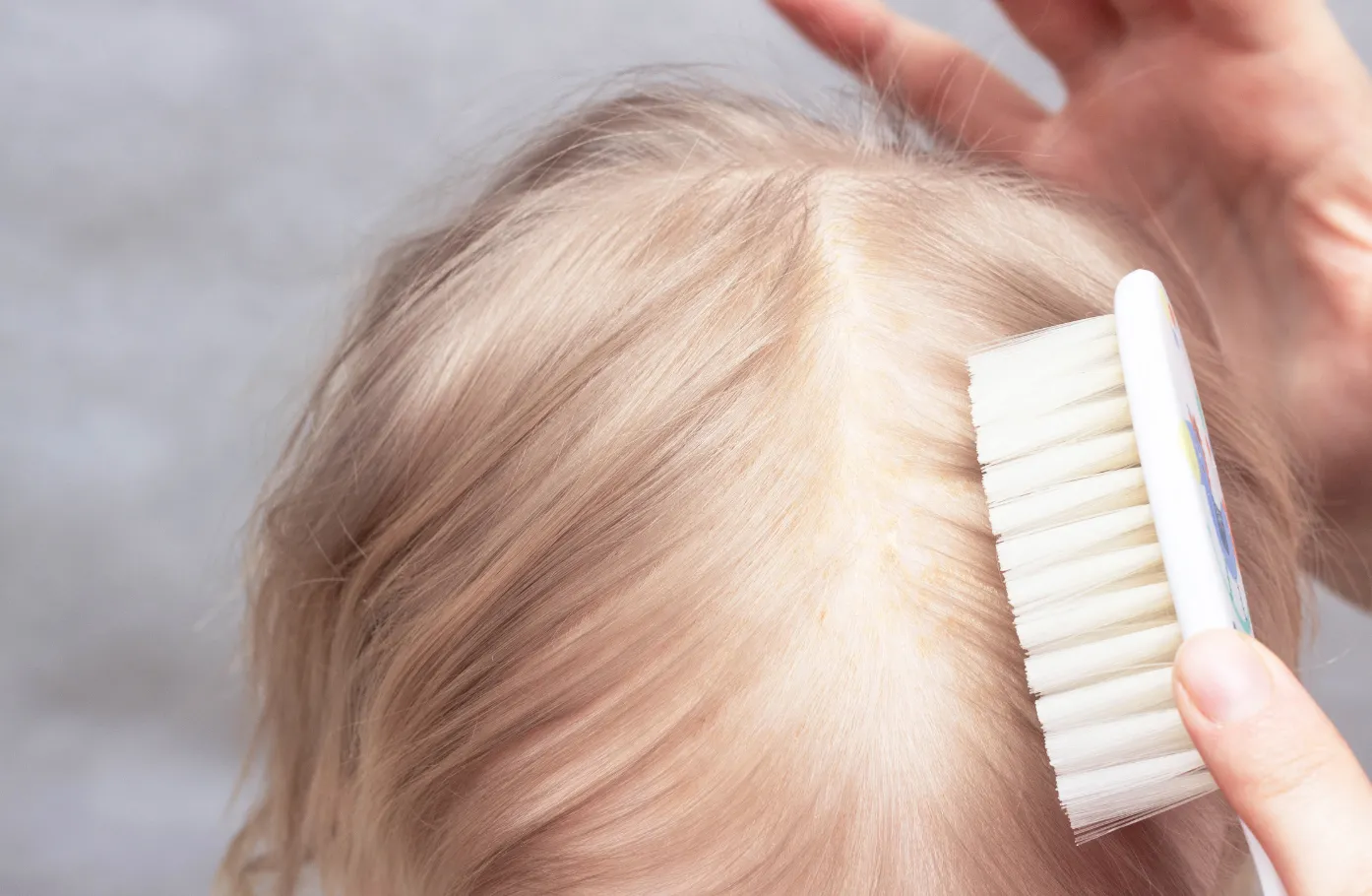
In hair loss consultations, seborrheic dermatitis is one of the most frequently mentioned — and most misunderstood — diagnoses.
Some people are told:
“Your hair loss is caused by seborrheic dermatitis.”
Others are reassured:
“Seborrheic dermatitis only affects the skin. It won’t cause hair loss.”
Both statements contain partial truth — and both miss the full picture within the broader framework of hormonal hair loss.
The Core Conclusion First
In hormonal hair loss, seborrheic dermatitis is rarely a single root cause.
But it is very often a bidirectional amplifier.
In other words:
- it may not appear first
- but once present, it can significantly worsen shedding
- and hormonal changes and hair loss can, in turn, make dermatitis worse
This creates a feedback loop — one that sits clearly within the causes and risk amplifiers of hormonal hair loss.
Pathway One:
How Hormonal Changes Set the Stage for Seborrheic Dermatitis
For many people, seborrheic dermatitis does not appear out of nowhere.
It commonly shows up during phases such as:
- perimenopause or menopause
- PCOS or insulin resistance
- after stopping birth control
- periods of prolonged stress
What these stages share is hormonal signaling that alters the scalp ecosystem.
What Do Hormonal Changes Actually Do to the Scalp?
They mainly affect three things:
- increased or dysregulated sebum production
- disrupted skin cell turnover rhythms
- reduced scalp barrier tolerance
As a result: small imbalances the scalp once handled quietly begin to escalate into visible inflammation.
At this point, seborrheic dermatitis becomes the scalp’s outward expression of internal hormonal shifts.
Pathway Two:
How Seborrheic Dermatitis Amplifies Hair Loss
Once inflammation is present, the issue goes far beyond surface discomfort.
Seborrheic dermatitis influences follicle behavior through several mechanisms.
Inflammatory Signals Shorten the Growth Phase
In an inflamed environment:
- growth-supporting signals are suppressed
- follicles enter the resting phase earlier
This does not permanently destroy follicles, but it significantly shortens the growth cycle.
This shortening effect becomes even more pronounced when nutritional stability is marginal, rather than clearly supportive.
The Scalp Is Interpreted as an “Unsafe” Environment
Hair follicles are extremely sensitive to local conditions.
On a scalp that is oily, itchy, and repeatedly inflamed, follicles tend to choose a conservative strategy: low investment, slow recovery.
This directly aligns with the “low-investment mode” described in earlier mechanism articles.
A similar low-investment logic is also observed during breastfeeding-related hormonal pathways, where growth is biologically deprioritized.
Hair Thinning Often Mirrors Areas of Inflammation
A common real-world observation:
- the areas that itch the most
- are often the areas that thin the fastest
This overlap is not coincidence.
Why People Get Stuck Asking “Which Came First?”
Because the starting point differs by individual.
For example:
- some develop seborrheic dermatitis first, then notice hair thinning
- others notice hair loss first, followed by scalp instability
But once both are present, the sequence matters far less than the interaction.
Two Common — but Misguided — Approaches
Many people fall into one of two extremes.
Extreme One: Blaming Everything on Dermatitis
- aggressive anti-inflammatory treatments
- ignoring hormonal or metabolic background
Result: the scalp improves temporarily, but hair loss never truly stabilizes.
Extreme Two: Ignoring Scalp Inflammation Entirely
- focusing only on hormones or nutrition
- tolerating oiliness, itching, and flare-ups
Result: the growth environment never becomes supportive, and recovery is constantly delayed.
The More Accurate Framework:
Two Lines That Amplify Each Other
A more helpful way to view this is:
- hormonal changes
→ reshape the scalp ecosystem
→ increase the likelihood of seborrheic dermatitis
- seborrheic dermatitis
→ amplifies inflammation and instability
→ makes hormonal hair loss more pronounced
This is not a simple cause–effect chain.
It is a feedback loop.
Why Managing Scalp Inflammation Is So Important in Hormonal Hair Loss
Because it is often the easiest point to interrupt the loop.
Hormonal shifts:
- take time
- cannot be instantly restructured
Scalp inflammation, on the other hand:
- is local
- is modifiable
- often responds more quickly
This is why, in earlier mechanism discussions, inflammation was consistently framed as an amplifier, not a root cause.
Gentle, low-interference daily care — such as a scalp-focused cleanser designed for hormonally sensitive and inflammation-prone phases — can help reduce unnecessary inflammatory noise while deeper recovery is ongoing.
Signs That Seborrheic Dermatitis Is Actively Amplifying Your Hair Loss
You may notice combinations such as:
- shedding closely tracking oiliness, itch, or burning
- seasonal or stress-related flare-ups worsening hair loss
- changes in washing frequency making things more unstable
- thinning concentrated in visibly inflamed areas
In these cases, dermatitis is not a side note.
It is a participant.
A Gentle but Important Reminder
Seborrheic dermatitis itself usually does not destroy hair follicles.
The real problem arises when it is:
- long-standing
- recurrent
- excluded from a broader recovery strategy
That is how it amplifies hair loss.
What This Article Completes Within the Hub
This article fills the final piece of the Causes / Risks framework:
- genetics → the background map
- hormonal events → the trigger
- stress and nutrition → amplifiers
- seborrheic dermatitis → the terminal amplifier
At this point, readers can clearly see: hair loss is not a single-point problem, but the result of multiple interacting pathways.
One-Sentence Summary
In hormonal hair loss, seborrheic dermatitis is rarely the cause — but when ignored, it is one of the strongest amplifiers.