
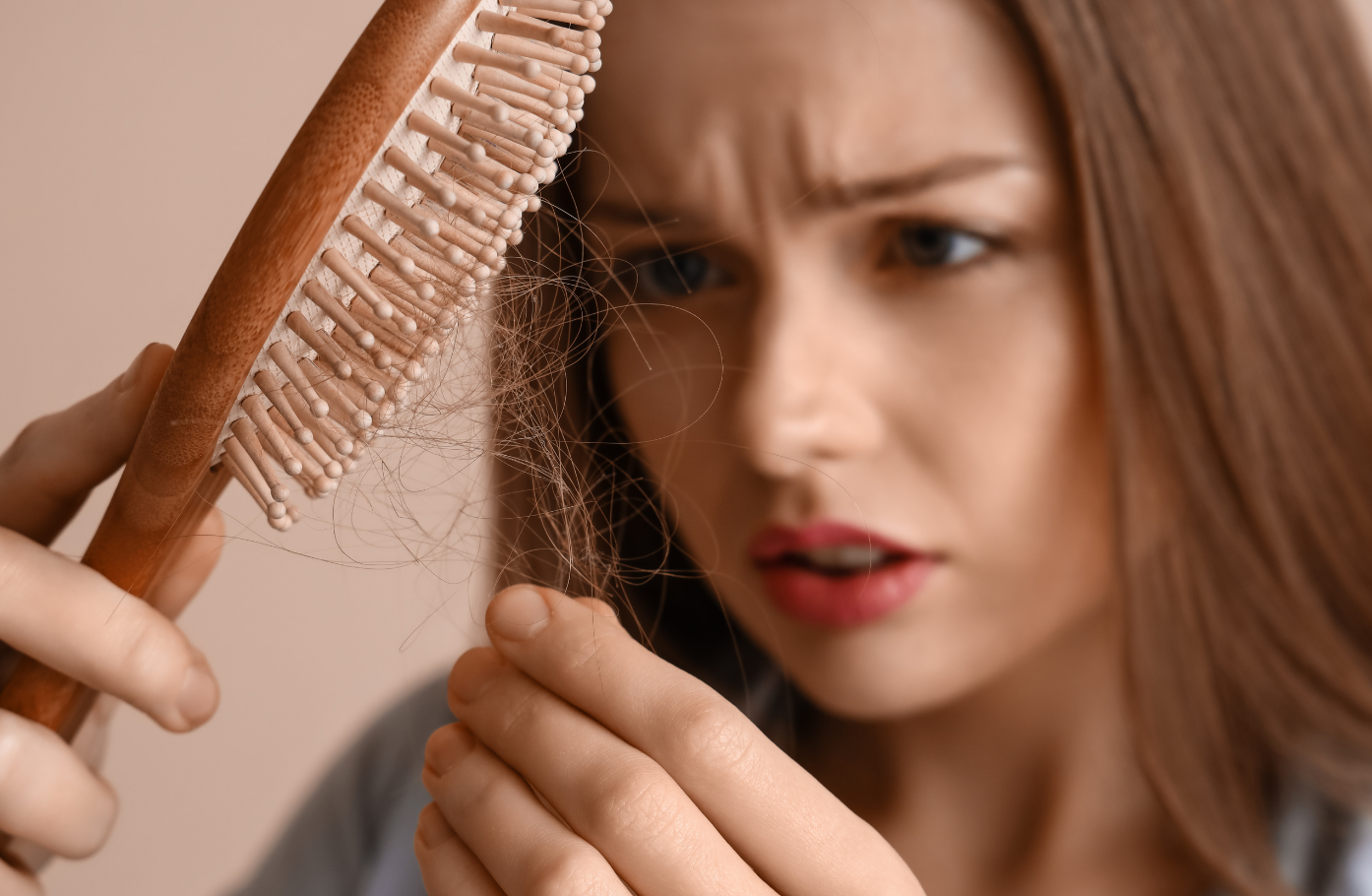
Hormonal hair loss affects more than the scalp. In the context of hormonal hair loss, its impact often extends far beyond visible shedding.
For many people, the most exhausting part isn’t the hair falling out itself — it’s not knowing when it will stop.
Many describe it in almost the same words:
“I can handle losing hair.
I just don’t know how long this is going to last.”
That sentence captures the true psychological core of hormonal hair loss — and why it can feel so deeply draining over time.
A Commonly Overlooked Fact
Hormonal hair loss rarely creates sudden psychological stress
Hormonal hair loss is different from acute events.
It usually doesn’t:
- start overnight
- reach a clear peak
- then end cleanly
Instead, it tends to:
- begin gradually
- fluctuate unpredictably
- lack a clear timeline
As a result, people are pulled into a mental state where the same question repeats every day — without a reliable answer.
That ongoing uncertainty, by itself, is psychologically exhausting.
Why Long-Term Uncertainty Is Harder Than Shedding Itself
Human psychology relies heavily on trend recognition.
You don’t necessarily need immediate improvement.
But you do need to know:
- whether things are moving in the right direction
- whether there is a limit
- whether this phase will eventually end
Hormonal hair loss disrupts all of that.
Because:
- shedding fluctuates
- progress is non-linear
- feedback is delayed
The brain stays stuck asking:
- “Am I getting worse again?”
- “Did I do something wrong?”
- “Is this becoming permanent?”
Without stable feedback, the nervous system struggles to stand down.
How Uncertainty Gradually Changes Mental State
Over time, this uncertainty often evolves into several subtle but persistent patterns.
Persistent Vigilance
Many people enter a constant monitoring mode:
- touching the scalp without realizing it
- checking mirrors repeatedly
- becoming unusually sensitive to lighting and angles
The scalp becomes a site of constant attention.
This is especially common when visual cues — such as part width — begin to feel threatening, a phenomenon explored further in the visibility pressure caused by a widening hair part.
Over-Interpreting Small Changes
Minor daily variations begin to carry heavy meaning:
- a few extra hairs today
- a part that looks slightly wider
- a vague “off” feeling in one area
Each detail is quickly interpreted as:
“Is this getting worse again?”
Emotional Drain Without Emotional Collapse
Importantly, many people are not visibly depressed or emotionally “falling apart.”
Instead, they live in a state of:
- tension
- low-level exhaustion
- difficulty fully relaxing
It’s not dramatic distress —
it’s ongoing depletion.
Why This Psychological Strain Is Often Misunderstood
From the outside, things may look normal.
You may still be:
- working
- socializing
- functioning day to day
And your hair loss may not appear “severe” to others.
So you hear comments like:
- “Try not to think about it so much.”
- “Lots of people lose hair.”
- “Just relax — stress makes it worse.”
But these responses miss the core issue.
The problem isn’t whether hair is falling.
It’s when you’ll finally know it won’t keep falling.
This misunderstanding is why the Mind & Myths layer of hormonal hair loss exists— to address what’s happening internally, not just what’s visible.
How Long-Term Uncertainty Can Quietly Interfere With Recovery
This is a critical layer that’s often overlooked.
Prolonged uncertainty keeps the nervous system in a semi-alert state:
- stress never fully settles
- fluctuations feel threatening
- tolerance for variability drops
As a result:
- care behaviors become more extreme
- “stimulating” solutions become more tempting
- routines are changed too frequently
This is exactly how anxiety can push people into endless searching and self-rescue behaviors— even when the system actually needs stability.
Ironically, these patterns are among the most common factors that disrupt recovery rhythms — even when intentions are good.
Why Wanting Clear Answers Is a Completely Human Response
Most people simply want to know:
- “Will this get better?”
- “How long will it take?”
- “Did I miss my window?”
This isn’t a personality flaw.
It’s a natural response to prolonged uncertainty without clear feedback.
The issue isn’t that you’re “thinking too much.”
The issue is that:
- the question has no immediate answer
- yet you’re forced to face it daily
That alone is mentally taxing.
What This “Mind” Section Is Designed to Address
The articles that follow will explore different psychological layers of hormonal hair loss, including:
- why changes in hair part visibility create such intense pressure
- how menopausal hair loss can disrupt self-identity
- why PCOS-related hair loss is often accompanied by shame
- how anxiety pushes people toward overstimulating care
- how to recognize real recovery signals instead of being ruled by short-term fluctuations
These pieces aren’t meant to tell you to “care less.”
They are meant to help you understand that the mental strain you’re experiencing
is a logical response to a difficult situation — not a personal weakness.
Final Takeaway
In hormonal hair loss:
- shedding is a physiological event
- long-term uncertainty is the psychological burden
You’re not struggling because you lack resilience.
You’re struggling because this process offers no clear endpoint — yet asks you to remain calm every single day.
For those looking to support recovery gently and consistently, a stable, low-interference routine — such as the approach behind the Evavitae Root Fortifying Hair Essence— is designed to reduce additional stressors rather than amplify them.
Next, we’ll begin with one of the most immediate triggers of uncertainty:
The visibility pressure caused by a widening hair part — and why it often feels harder than short-term shedding itself.