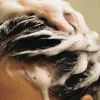

This is a hair care framework designed to reduce loss, not a checklist for “stimulating hair growth.”
Throughout the previous sections, we have repeatedly emphasized one core principle:
In nutrition-deficiency-related hair loss, the primary goal of care is damage control, not stimulation.
Many people get stuck on a practical question:
“I know I shouldn’t over-stimulate my scalp, but what exactly should I do so that my care routine is not making things worse?”
This article exists to answer that question.
We have systematically broken down everyday scalp and hair behaviors most likely to create additional loss into six dimensions.
You do not need to do everything perfectly at once. You only need to ensure that, across these six areas, you are not continuously draining the limited recovery resources your body already has (Scalp Care & Routine).
Why Use “Six Dimensions” Instead of a List of Random Tips?
Nutrition-deficiency hair loss is not a “single-point problem.” It behaves like a system under chronic strain:
Long-term low energy availability
Multiple small stressors stacking up
Recovery rhythms repeatedly interrupted
Focusing on one action—like shampoo choice, scalp massage, or supplements—while ignoring other sources of depletion often results in:
Fixing in one place, leaking in another.
The value of the six-dimension framework lies in its ability to:
Systematically seal hidden “leaks”
Make care behaviors controllable and repeatable
Provide a stable external environment for recovery
Dimension One: Cleansing Method
Less Stimulation Matters More Than “Feeling Extra Clean”
During a nutrition-deficient phase, the scalp is not afraid of being slightly oily. What it fears most is repeated stimulation.
The first trap many people fall into is:
Aggressive oil removal (Gentle Cleansing)
Over-cleansing
Chasing strong “fresh” or “cooling” sensations
Excessive cleansing can lead to:
Damage to the scalp barrier (Barrier Repair)
Increased background micro-inflammation (Anti-Inflammatory Balance)
Lower shedding threshold
Key question: After washing, does your scalp feel calm or reactive?
Dimension Two: Washing Frequency
Stability Matters More Than “Getting the Number Right”
Many search for a “standard answer” on how often to wash hair. In nutrient-deficiency hair loss, the number itself matters less than whether your scalp is repeatedly pulled into:
Cleaning → stimulation → stress response
Washing too often → cumulative cleansing stress (Hair Washing Frequency)
Washing too infrequently → oil buildup, inflammation
Goal: stability. Frequency that produces the least fluctuation in scalp condition qualifies as reasonable.
Dimension Three: Mechanical Damage
The Most Underestimated Source of Hair Loss
Much of what appears as hair loss is actually breakage. Common sources:
Pulling on wet hair
Rough brushing/detangling (Avoiding Mechanical Damage)
Tight hairstyles
Friction during sleep
Fragile hair shafts amplify these effects. Core goal: do not allow already-limited hair density to be lost prematurely.
Dimension Four: Heat Management
Heat Is Not the Enemy, Excess Is
Hair dryers, curling irons, and flat irons do not directly cause hair loss. However, nutrient deficiency increases hair vulnerability (Heat Management):
Hair fiber repair capacity is reduced
Moisture/protein lost more quickly
Breakage harder to recover visually
This dimension asks:
Is the temperature too high?
Is the heat too close to the scalp?
Is usage exceeding tolerance?
Dimension Five: Massage Method
Massage Improves Conditions, Not Nutrition
Scalp massage cannot create nutrients, only optimize local conditions (Scalp Massage). Improper massage may:
Overstimulate scalp
Worsen inflammation
Amplify discomfort
Key words: gentle, brief, recoverable. Purpose: support environment, not force a reaction.
Dimension Six: Scalp Environment Management
Creating a Low-Noise Background for Recovery
Scalp environment includes:
Barrier integrity (Barrier Repair)
Baseline inflammatory activity (Anti-Inflammatory Balance)
Sensitivity to external stimuli
Long-term discomfort (itching, tightness, burning) prevents recovery signals from being executed (Scalp Environment).
Shared Principles Across All Six Dimensions
Do not introduce additional stimulation
Do not chase immediate feedback
Choose sustainable actions
If a behavior requires gritting teeth, pushing through discomfort, or constant escalation, it is likely unsuitable for recovery.
What Comes Next: Breaking Down Each Dimension
Upcoming articles will examine:
Why aggressive oil removal backfires (Gentle Cleansing)
How to adjust washing frequency (Hair Washing Frequency)
Common mechanical damage forms (Avoiding Mechanical Damage)
Safety boundaries for heat management (Heat Management)
How to massage without overstimulation (Scalp Massage)
How to recognize improvement in scalp environment (Scalp Environment)
You do not need to do everything at once. Stopping the system from continuous overdrawing is already the beginning of recovery (Evavitae Root Fortifying Hair Essence).