
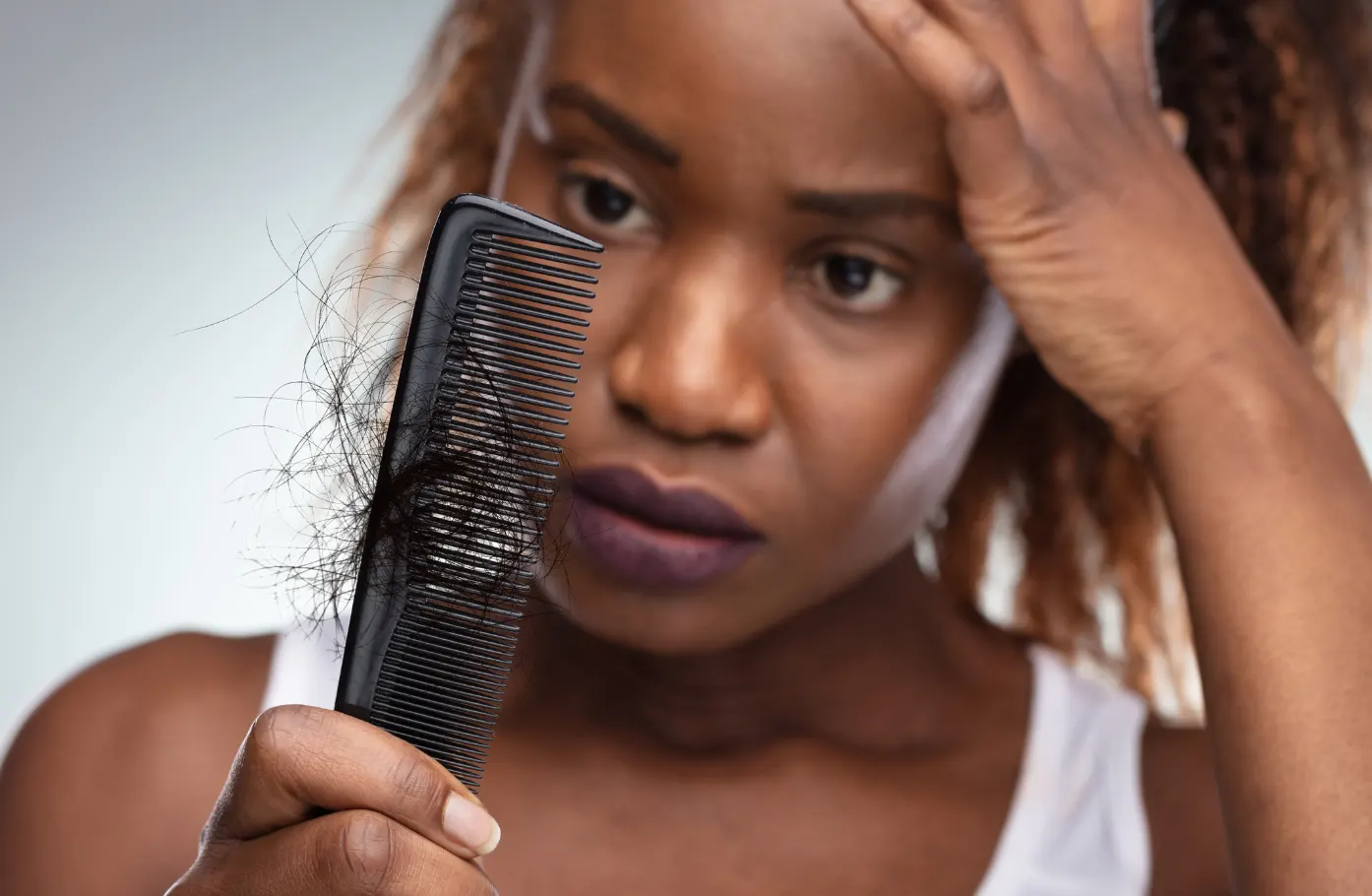
Many new moms experience significant hair shedding 2–6 months after giving birth and worry:
- “Am I starting hereditary hair loss?”
- “Losing this much hair—am I going bald?”
- “Is this temporary or permanent?”
This is one of the most common anxieties for postpartum women.
From a medical perspective, postpartum hair loss (Postpartum Telogen Effluvium, PTE) and genetic hair loss (female pattern hair loss, AGA) are completely different. They have distinct mechanisms, appearances, and recovery rates.
This article will help you clearly and easily determine:
- Whether you are experiencing postpartum hair loss or genetic hair loss
- What signs indicate it’s temporary
- When further testing is needed
- How to respond and care for your hair properly
1. What is Postpartum Hair Loss? (Postpartum Telogen Effluvium, PTE)
Postpartum hair loss is a telogen effluvium, where a sudden drop in hormones causes many hair follicles to enter the resting (telogen) phase simultaneously, resulting in noticeable shedding 2–6 months after delivery.
Core features:
- Temporary
- Reversible
- Hair follicles remain intact
Recovery period: usually 6–12 months.
For a breakdown of the typical signs of postpartum shedding, see: 👉 Typical Signs of Postpartum Hair Loss
This means postpartum hair loss is not a disease and will not cause permanent baldness.
2. What is Genetic Hair Loss? (Androgenetic Alopecia, AGA)
Female pattern hair loss (AGA) is caused by genetic and hormonal factors. The root cause is hair follicles being overly sensitive to dihydrotestosterone (DHT), leading to:
- Gradual miniaturization of follicles
- Hair strands becoming thinner and softer
- Shortened growth phase
- Progressive follicle degeneration
Characteristics:
- Progressive (worsens over time)
- Irreversible (cannot fully recover)
- Not directly related to pregnancy or childbirth
It requires long-term management rather than waiting for natural recovery.
3. PTE vs. Genetic Hair Loss: Key Differences
Type | Trigger | Hair Loss Area | Recovery |
Postpartum Telogen Effluvium (PTE) | Hormone drop (sudden estrogen decline) | Overall thinning, most noticeable at temples | Fully recoverable |
Female Pattern Hair Loss (AGA) | Follicle sensitivity to DHT | Thinning on top, widened part line, crown collapse | Not fully reversible |
In short:
- Sudden heavy shedding at 2–6 months → likely postpartum hair loss
- Gradual thinning over time → likely genetic hair loss
4. Timing Is the Simplest and Most Accurate Way to Identify
Postpartum Hair Loss (PTE):
- Typically occurs 8–16 weeks postpartum
- Noticeable delay after delivery
- Sudden, heavy shedding at a clear peak
For a full breakdown of how long postpartum shedding lasts and why, see: 👉 Timeline of Postpartum Hair Loss
Female Pattern Hair Loss (AGA):
- No sudden outbreak
- No “a handful at a time” shedding
- Slowly progresses year by year
Rule of thumb: sudden, concentrated shedding = PTE; gradual thinning = AGA.
5. Hair Loss Location: Where It Thins Matters
Postpartum Hair Loss:
- Diffuse shedding
- Temples and hairline most affected
- Hair falls out in showers, on pillows, in drains
- “M-shaped” hairline possible
- Short, fine new hairs appear as hair regrows
Genetic Hair Loss (AGA):
- Top of the scalp and part line most affected
- Hairline usually unchanged
- Hair becomes thinner, softer, flatter
- Part line widens, ponytail thins
- Crown looks increasingly shiny
Rule: thinning at the temples = likely PTE; thinning on top = consider AGA.
6. Recovery Matters: Can You Regrow Hair?
Postpartum Hair Loss (PTE):
- Full recovery possible
- Hair follicles intact
- New hair starts regrowing around 4–6 months
- Most recover to pre-pregnancy state by 9–12 months
- Delayed recovery often linked to nutrition or stress
For why some mothers shed more severely or recover more slowly, see: 👉 Why Some Women Experience More Severe Postpartum Hair Loss
AGA (Genetic Hair Loss):
- Cannot fully recover
- Hair follicles progressively miniaturize
- Hair becomes finer
- Does not improve naturally
- Requires long-term management
Rule: hair regrows → PTE; no recovery → AGA.
For a deeper understanding of why postpartum shedding is reversible, see: 👉 Postpartum Hair Loss Is Not a Disease — It’s a Physiological Reset
7. When Both Conditions May Overlap
Some women have both:
- Postpartum hair loss (hormone drop)
- Genetic sensitivity to DHT (AGA)
Signs:
- Shedding begins postpartum
- Continues beyond 12–18 months
- Top of scalp remains thin
- Hairline may recover, but crown stays sparse
This requires a more targeted plan.
8. Quick Self-Check: 5 Key Questions
- Did shedding start 2–6 months postpartum? → Likely PTE
- Was the shedding sudden and heavy? → PTE typical
- Where is the thinning most noticeable? → Temples = PTE; Top = AGA
- Is hair falling out in “handfuls” during washing? → PTE
- Are hairs gradually getting thinner, flatter, softer? → AGA
9. When to See a Doctor or Get Tested
Seek further evaluation if:
- Shedding continues beyond 12–18 months
- Top of scalp is noticeably thin
- Part line keeps widening
- Irregular periods (possible hormone issues)
- Severe fatigue, cold hands/feet (possible iron deficiency)
- Palpitations, anxiety (possible thyroid problem)
Tests to consider:
- Ferritin (iron)
- Vitamin D
- TSH / T3 / T4 (thyroid function)
- DHT / Androgen panel (if AGA suspected)
10. Summary: 80–90% of Postpartum Hair Loss Is Reversible
Remember:
- Postpartum Hair Loss: hormone drop → temporary → fully recoverable
- Genetic Hair Loss: genes + DHT → progressive → will not recover naturally
Key identification rules:
- Sudden heavy shedding → postpartum hair loss
- Gradual thinning, top of scalp → genetic hair loss
- Hairline thinning → postpartum hair loss
- Widening part line → genetic hair loss
Understanding these distinctions helps you stay calm. Postpartum hair loss is fully recoverable.
For mothers seeking clarity and reassurance, our Postpartum Hair Loss offers a detailed, easy-to-understand overview.
If you want to learn more about the mechanism, explore: 👉 Postpartum Mechanism Hub
Many new mothers find that switching to a low-irritation formula such as the Evavitae Root Fortifying Hair Essence helps reduce scalp discomfort.


Add comment
You must be logged in to post a comment.